-
Need a
StatuspageAtlassian
Statuspage Atlassian
alternative?Try Pulsetic. More subscribers, more teammates - for a lower price.
No credit
card required.
$HTTP_PROTOCOL = (isset($_SERVER['HTTPS']) && ($_SERVER['HTTPS'] == 'on' || $_SERVER['HTTPS'] == 1)) || (isset($_SERVER['HTTP_X_FORWARDED_PROTO']) && $_SERVER['HTTP_X_FORWARDED_PROTO'] == 'https') ? 'https://' : 'http://'; $SITE_URL = $HTTP_PROTOCOL . $_SERVER['SERVER_NAME'] . '/'; ?>
Try Pulsetic. More subscribers, more teammates - for a lower price.
Websites go down for all kinds of reasons. It’s inevitable; at some point, it will happen to your website too. And it’s essential you’re the first one to know.
Pulsetic monitors your uptime from 15 locations around the world, giving you and your customers beautiful, real-time updates in every language.
But there’s another reason people looking for a Statuspage Atlassian alternative come to Pulsetic: the functionality you get for your money.
Let’s compare the two.
Beautiful status badges
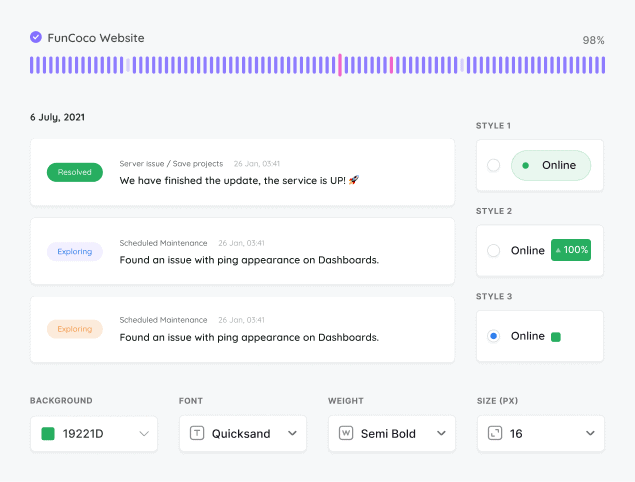
Unlike Statuspage Atlassian, Pulsetic gives you a white labeled badge showing your service availability in real time - on any page you like. You can customize it to your brand in minutes: colors, fonts, symbols, text, and backgrounds. And if you need more freedom to make it yours, you can use Custom CSS instead.
30 second uptime checks
Statuspage Atlassian and Pulsetic can both check things are OK every 30 seconds, depending which plan you choose. If you want to, though, you can also space out the intervals between checks.
Support for every language
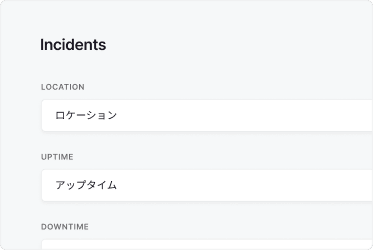
Statuspage Atlassian works in English - and only English. The world’s 6 billion people who don’t speak English need a Statuspage Atlassian alternative. Pulsetic, on the other hand, supports every language on earth: from Spanish to Swahili. So wherever your customers are, you can let them know what’s happening.
“Tens of thousands of business owners from around the world rely on our service, and Pulsetic is the best platform there is to ensure we communicate any downtimes clearly and swiftly to our customers to avoid panic and disappointment. Getting setup on Pulsetic not only been smooth and easy but super joyful too, the design is stunning and customisable unlike any other monitoring platform we’ve used.”
Leo Bassam
Founder, CEO at Plutio
Free plans
Statuspage Atlassian’s free plan gives you access to 100 subscribers, 25 components, email notifications and Slack notifications. On Pulsetic’s free plan, though, you’ll get unlimited, full-featured status pages, as well as custom domains.
Solo plans
On the cheapest paid plan ($29/month), Statuspage Atlassian gives you 250 subscribers and basic customization. Pulsetic’s alternative to Statuspage Atlassian is better value; for $9/month you’ll get complete customization for your status page and badges, as well as notifications for up to 1,000 subscribers.
Team plans
If you need to know what’s happening by voice call, Pulsetic is the best Statuspage Atlassian alternative. Pulsetic’s Team plan gives you 100 credits for SMS and voice call alerts; with Statuspage, you’ll get unlimited SMS alerts but no voice call functionality. Pulsetic Team also lets you work with up to 2 teammates.
Statuspage Atlassian
Free plan / trial
Free Plan
Free Plan
Price (USD/mo)
$9
$29
Monitoring
Check time
30 sec
N/A
Choice of regional data centers
✕
SSL monitoring
✕
Keyword monitoring
✕
Ping / ICMP monitoring
✕
Port monitoring
✕
TCP monitoring
✕
Domain monitoring
✕
Cron / heartbeat monitoring
✕
Custom HTTP requests
✕
Customized responses
✕
API
MCP server
✕
n8n integration
✕
Monitoring data retention
Up to 5 yr
n/a
Status Pages
Incident updates
Status updates for subscribers via email
Maintenance windows
Status badges
Customized domain
Customized colors
Customized logo
Remove branding
✕
Customized status page layout
CSS customization
Custom email sender & templates
✕
AI writing assistant
✕
Page translations
✕
Password-protected status page
Notifications
Email alerts
SMS alerts
Phone call alerts
✕
Slack alerts
MS teams alerts
Discord alerts
✕
Telegram alerts
✕
Mattermost alerts
✕
Webhooks alerts
Zapier alerts
✕
Twilio alerts
✕
Datadog integration
Integration with SIGNL4
✕
Analytics
See response times
✕
Response time by location
✕
Custom date range reports
✕
Scheduled email reports
✕
Security
Two-factor authentication
Single Sign-On (SAML)
Role-based access
Support
Chat
✕
Human Support
AI Support
Helpdesk Articles
Email Support
Comparison based on publicly available information as of June 2026. Features and pricing change frequently, so please verify current details on each provider’s website.
See where your website is loading slowly
We’ll check your website response times from different locations around the world, so you know if there’s an issue in a particular region.
Alerts wherever you want them
Pulsetic lets you know the moment your website is down, through Slack, Telegram groups, Webhooks, email, SMS or voice call.
Never let your SSL expire again
We’ll let you know when it’s time to update your SSL certificate - so you can renew it before customers are seeing error messages.
2-minute setup · Cancel any time
No credit card needed
No. Statuspage is a status-page and incident-communication product only, so it does not check whether your websites or servers are actually up. You have to run a separate uptime monitoring tool and feed status into it, either manually or through integrations. Pulsetic combines both: it monitors uptime and hosts your status page in a single tool, so you do not need to buy or wire up a second product.
Statuspage's paid plans start at $29 per month and the price climbs as your subscriber count grows, reaching $99 per month at 1,000 subscribers, $399 per month at 5,000, and $1,499 per month at 25,000. On top of that you still need a separate monitoring service, so the real total is higher than the sticker price. Pulsetic starts at $9 per month and bundles monitoring and status pages together, which is why teams switch to cut costs.
Each Statuspage tier caps how many subscribers can follow your page, and you move up a plan once you cross the limit. The jumps are large: $29 per month covers 250 subscribers, $99 per month covers 1,000, $399 per month covers 5,000, and the top public tier is $1,499 per month for 25,000. With Pulsetic, paid plans start at $9 per month with subscriber notifications included, so a growing audience does not push you into an enterprise-priced tier as quickly.
Pulsetic is a strong option because it does the two jobs you would otherwise pay for separately: uptime monitoring and a customizable status page with subscriber notifications and status badges. Plans start at $9 per month and there is a free plan, versus Statuspage starting at $29 per month for the page alone plus a separate monitoring tool. You get one bill, one login, and one place to manage everything.
Statuspage does not run any checks itself, so it cannot detect outages on its own. Pulsetic actively monitors HTTP(S), SSL certificates, keywords, ping or ICMP, ports, TCP, domains, and cron or heartbeat jobs, with checks as frequent as every 30 seconds. When something goes down it can update your status page and alert your subscribers automatically, instead of waiting for a human to post an incident.
Yes. You can recreate your status page in Pulsetic, set up your monitors, point your custom domain over, and invite your subscribers to follow the new page. Because Pulsetic also handles the monitoring, the move can also let you retire the separate monitoring tool you were running alongside Statuspage. If you need a hand mapping components or importing data, the support team can guide you.
Yes, Pulsetic offers a free plan that includes a full-featured status page. Statuspage's free tier exists but is limited to 100 subscribers, blocks custom domains, and still includes no monitoring, so you would need another tool just to know when you are down. Pulsetic lets you start free with both monitoring and a status page, then upgrade from $9 per month as you grow.
Yes. Pulsetic status pages are fully customizable and can run on your own custom domain, so they match your brand and sit alongside your product. You can apply your logo and colors, embed a status badge, and let visitors subscribe for updates. Because monitoring is built in, the page updates automatically when a monitored service goes down, which a status-page-only tool like Statuspage cannot do on its own.
Stay online, all the time, with Pulsetic's uptime prime.
By Designmodo
Designmodo Inc. 169 Madison Ave, #79627, New York, NY 10016, United States
Copyright © 2010-2026