• Need a Freshping underline
    alternative?

    Try Pulsetic. More features, more peace of mind.

    Learn why...

    No credit
    card required.

  • Looking for Freshping alternative?

Pulsetic vs Freshping: the breakdown

The average website goes down for three hours per month. And a lot can happen in three hours. Lost revenue. Lost brand trust. Lost customers.

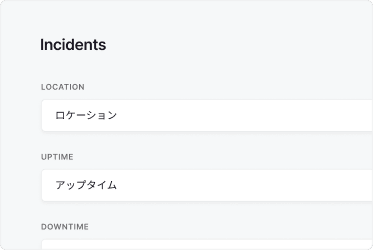
That’s why Pulsetic monitors your uptime from 15 locations around the world, giving you and your customers beautiful, real-time updates in every language.

But there’s another reason people looking for a Freshping alternative come to Pulsetic: the functionality.

Let’s compare the two.

  • Beautiful status badges

    Beautiful status badges

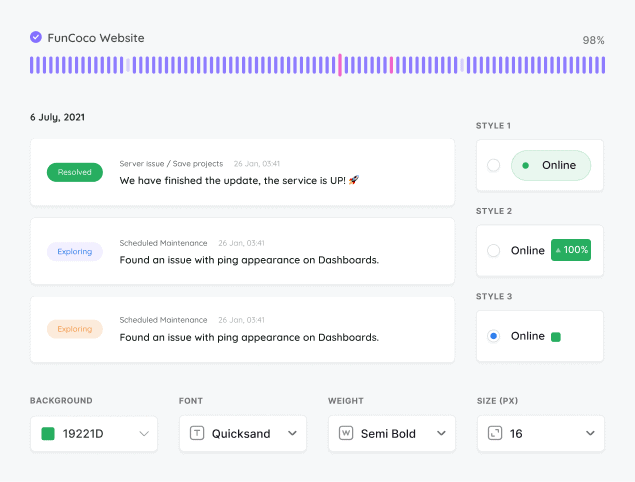
    Both Pulsetic and Freshping give you white labeled badges showing your service availability in real time - on any page you like.
    With Pulsetic, though, you can customize your badge using your brand colors, fonts, symbols, text, and backgrounds. And if you need more freedom to make it yours, you can use Custom CSS instead.

  • Beautiful status badges

    30 second uptime checks 

    Freshping checks things are OK every minute. With Pulsetic, you can know about an incident in half the time: within 30 seconds. If you want to, you can also space out the intervals between checks. Freshping monitors your uptime from 15 locations around the world, versus 15 for Pulsetic.

  • Support for every language 

    Support for every language

    Freshping works in English - and only English. The world’s 6 billion people who don’t speak English need a Freshping alternative. Pulsetic, on the other hand, supports every language on earth: from Spanish to Swahili. So wherever your customers are, you can let them know what’s happening.

  • “The monitoring tool we've been waiting for. Super easy to set up monitoring, customizable status page design, and access to notifications across Slack, email and SMS. Pulsetic is awesome.”

  • Review person

    Andrei Negrau

    CEO, Cartloop.io

Pricing: Pulsetic vs Freshping

  • Free plans

    Freshping’s service is free. You can create up to 5 status pages with unique URLs. On Pulsetic’s free plan, you can create as many status pages as you like. You can also customize the appearance of your status pages on Freshping - but it’s not as easy as Pulsetic. You have to contact customer service.

  • Solo plan

    As an alternative to Freshping, you have complete freedom on Pulsetic’s Solo plan to customize your status pages and badges however you like. And if you’re experiencing downtime, you can also send notifications to up to 1,000 subscribers.

  • Team plans

    If you need to know what’s happening by voice call, Pulsetic’s Team plan is the best Freshping alternative. It gives you 100 credits for SMS and voice call alerts. You also have 5,000 subscriber notifications.

Feature comparison

PulseticPulsetic

Freshping (discontinued)

Free plan / trial

Free Plan

n/a

Price (USD/mo)

$9

n/a

Monitoring

Check time

30 sec

n/a

Choice of regional data centers

n/a

SSL monitoring

n/a

Keyword monitoring

n/a

Ping / ICMP monitoring

n/a

Port monitoring

n/a

TCP monitoring

n/a

Domain monitoring

n/a

Cron / heartbeat monitoring

n/a

Custom HTTP requests

n/a

Customized responses

n/a

API

n/a

MCP server

n/a

n8n integration

n/a

Monitoring data retention

Up to 5 yr

n/a

Status Pages

Incident updates

n/a

Status updates for subscribers via email

n/a

Maintenance windows

n/a

Status badges

n/a

Customized domain

n/a

Customized colors

n/a

Customized logo

n/a

Remove branding

n/a

Customized status page layout

n/a

CSS customization

n/a

Custom email sender & templates

n/a

AI writing assistant

n/a

Page translations

n/a

Password-protected status page

n/a

Notifications

Email alerts

n/a

SMS alerts

n/a

Phone call alerts

n/a

Slack alerts

n/a

MS teams alerts

n/a

Discord alerts

n/a

Telegram alerts

n/a

Mattermost alerts

n/a

Webhooks alerts

n/a

Zapier alerts

n/a

Twilio alerts

n/a

Datadog integration

n/a

Integration with SIGNL4

n/a

Analytics

See response times

n/a

Response time by location

n/a

Custom date range reports

n/a

Scheduled email reports

n/a

Security

Two-factor authentication

n/a

Single Sign-On (SAML)

n/a

Role-based access

n/a

Support

Chat

n/a

Human Support

n/a

AI Support

n/a

Helpdesk Articles

n/a

Email Support

n/a

Comparison based on publicly available information as of June 2026. Features and pricing change frequently, so please verify current details on each provider’s website. Freshping was discontinued by Freshworks in 2026.

And there’s more in Pulsetic’s free plan…

  • Find why your website is slow

    See where your website is loading slowly

    We’ll check your website response times from different locations around the world, so you know if there’s an issue in a particular region.

  • Find why your website is slow

    Alerts wherever you want them

    Pulsetic lets you know the moment your website is down, through Slack, Telegram groups, Webhooks, email, SMS or voice call.

  • Find why your website is slow

    Never let your SSL expire again

    We’ll let you know when it’s time to update your SSL certificate - so you can renew it before customers are seeing error messages.

  • Don't wait for Freshping to disappear. Move to a tool that's here to stay.

    2-minute setup · Cancel any time

  • No credit card needed

Frequently asked questions

  • Is Freshping shutting down?

    Yes. Freshworks has retired Freshping as part of a portfolio cleanup so it can focus on Freshdesk and Freshservice. Free accounts were switched off in early 2026, paid plans run until their current term ends and will not renew, and exported data is permanently deleted after a short grace period. Freshworks does not point users to a specific replacement, so former Freshping customers need to choose a new monitoring tool on their own.

  • What is the best Freshping replacement?

    Pulsetic is a natural, like-for-like replacement: it pairs uptime monitoring with built-in status pages in one tool, just like Freshping did. It checks your websites as often as every 30 seconds and supports HTTP(S), SSL, keyword, ping or ICMP, port, TCP, domain, and cron or heartbeat monitors. It also keeps the part people liked most about Freshping by offering a free plan to get started.

  • How do I migrate from Freshping to Pulsetic?

    Freshworks does not provide a direct transfer, so the move is a quick manual rebuild. Export your Freshping configuration while you still have access, then add the same URLs as monitors in Pulsetic, set your alert contacts and integrations, and publish a status page to replace your old one. Most teams recreate their checks in well under an hour, and you can start on Pulsetic's free plan to test everything before your Freshping account fully closes.

  • Is Pulsetic a good alternative to Freshping?

    Yes. Pulsetic covers the same core jobs Freshping did, monitoring your websites and APIs and showing status to your users, in a single modern platform that is actively maintained. On top of standard HTTP(S) uptime checks it adds SSL, keyword, port, TCP, domain expiry, and cron or heartbeat monitoring, plus status pages with subscriber notifications and status badges. For most former Freshping users it is a straightforward upgrade rather than a compromise.

  • Does Pulsetic have a free plan like Freshping?

    Yes. Pulsetic offers a free plan so you can replace your Freshping monitoring without paying upfront, which matters now that Freshping itself is no longer an option. The free plan lets you set up monitors and try the core features, and you can move to a paid plan later if you need more monitors, faster check frequency, or advanced status page options. Paid plans start at $9 per month.

  • What features does Pulsetic offer compared to Freshping?

    Pulsetic monitors HTTP(S), SSL certificates, keywords, ping or ICMP, ports, TCP, domain expiry, and cron or heartbeat jobs, with checks as frequent as every 30 seconds. It sends downtime alerts through many integrations and publishes hosted status pages with subscriber notifications and embeddable status badges. That matches Freshping's monitoring and status page combination while adding check types, such as SSL and domain expiry, that Freshping did not focus on.

  • Can Pulsetic create status pages like Freshping did?

    Yes. Status pages are a built-in part of Pulsetic, so you can show real-time and historical uptime to your customers just as you did with Freshping. Visitors can subscribe to get notified when an incident starts or is resolved, and you can add a status badge to your own website. This makes Pulsetic a clean one-tool replacement for both Freshping's monitoring and its public status page.

  • Can Pulsetic monitor APIs, cron jobs, and heartbeats?

    Yes. Alongside website and SSL checks, Pulsetic can monitor API endpoints and use heartbeat or cron job monitoring to confirm scheduled tasks ran on time. Your job sends a periodic ping, and Pulsetic alerts you if that signal is late or missing. This covers background tasks and APIs that a basic uptime ping would not catch.