Website Monitoring That Tells You First

Pulsetic loads your website as often as every 30 seconds from up to 15 regions, confirms a failure elsewhere before it wakes anyone, and shows your visitors a status page while you fix it.

* No credit card required

Made for You

  • Hear it from us, not a customer

    The first person to notice your website is down should not be the one about to buy something. Checks run around the clock and the alert goes out the moment one fails.

  • One failed check is not an outage

    Every failure is re-checked from other regions before an alert fires, so a broken route between one data center and your server does not become a 3am phone call.

  • Tell your visitors before they ask

    A branded status page on your own domain updates itself from your monitors, and subscribers get emailed as the incident opens, updates and resolves.

Trusted by teams at companies around the world

"Pulsetic made monitoring something I barely think about anymore. The interface is clean and the tracking is real-time, so I can glance at my site’s performance and get back to work."

Koen Kanters
Koen Kanters

Senior Software Engineer at ASML

"Pulsetic is easy-to-use and simple to get started. As an agency, I like that it includes unlimited status pages, because I can create one for each of my clients. Pulsetic includes every alert channel that I want, and advanced settings that give me greater confidence in the uptime. I can require that a response include certain text and respond within a certain timeframe in order for a site to be considered online. This gives me assurance that we would be notified if there were major performance issues or a bad deployment that made the site unusable. These features come with every paid plan, so our monthly bill is predictable. The API is a huge bonus on the teams plan. We have used it to add maintenance windows for certain monitors automatically based on events that happen in other software we use."

Christopher Morbitzer

CEO at NorthBuilt

"Pulsetic’s monitoring is easy to set up via their super clean, user-friendly UI. I was up and running within only a few minutes. A helpful knowledge base is available for webmasters to refer to if needed. Pulsetic’s pricing is also some of the most competitive in the industry. I highly recommend them for emerging and established agencies alike."

Scott Werley
Scott Werley

Owner at Sporulate Design

"Pulsetic is easy to set up and integrate. You don’t need much time to get it running. The interface is clear and simple. It’s easy to see what’s going on at a glance. The design looks great, too. I had no trouble finding what I needed and monitoring my sites is straightforward. If you want a simple tool that works well, Pulsetic is a good choice."

Aryo Sayogha
Aryo Sayogha

CEO at MBDC Media

"The monitoring tool we’ve been waiting for. Super easy to set up monitoring, customizable status page design, and access to notifications across Slack, email and SMS. Pulsetic is awesome."

Andrei Negrau
Andrei Negrau

CEO at Siena AI

"Tens of thousands of business owners from around the world rely on our service, and Pulsetic is the best platform there is to ensure we communicate any downtimes clearly and swiftly to our customers to avoid panic and disappointment. Getting setup on Pulsetic not only been smooth and easy but super joyful too, the design is stunning and customisable unlike any other monitoring platform we’ve used."

Leo Bassam
Leo Bassam

Founder, CEO at Plutio

"Pulsetic cut down our uptime monitoring work a lot. We automated uptime tracking and SLA reporting, which took a chunk of manual effort out of our monthly and annual reports. The Slack and email alerts let the team jump on problems quickly, and the API is what really sold us, since we point a dedicated health-check endpoint at it and pull uptime data straight into our internal workflows."

Mariana Kodama
Mariana Kodama

Treasurer, Fundacion Jorge Luis Borges

"There’s an easy way for you to monitor your online project. After all the hard work you have put into going live, you want to make sure that things keep running smoothly while you focus on the next project."

Chris Kalmar
Chris Kalmar

Founder at nineLemon

"Pulsetic is fast and genuinely easy to use. The UI is clean and has the features we actually needed, the status pages look good, and being able to route alerts to several channels was a real plus for us."

Akis Laopodis
Akis Laopodis

Founder at Qurioos

"Pulsetic helps us monitor all of our websites and webapps over at Pairing.dev. Before we used it, we had no idea how often services (e.g. heroku) were offline. Now we have complete control over it."

Till Carlos
Till Carlos

Founder at Pairing.dev

"Using Pulsetic is a big win for us! Our dev team can now deliver faster, with zero time spent monitoring our website uptime. Plus the interface is great and analytics proper."

Razvan Popescu
Razvan Popescu

Head of Marketing at AbstractAPI

A Website Is More Than One Page

  • Pages and endpoints

    HTTP and HTTPS monitors load any URL and alert on unexpected status codes, whether that is your homepage, your checkout, or the API behind your app.

  • Content that should be there

    A page can return 200 with the signup button missing. Keyword monitoring checks the response for text that should or should not be present.

  • Certificates and domains

    An expired certificate takes a site down as completely as a dead server. SSL monitoring and domain monitoring warn you well before the date.

  • Servers and services

    Ping, port and TCP monitors confirm the machine answers and the service behind it is still accepting connections.

  • Jobs that run out of sight

    Backups, order emails and scheduled imports fail quietly. Cron monitoring expects a ping on schedule and tells you when it does not arrive.

  • What real visitors got

    A site can be up and still be unusable. Real user monitoring records load times, Core Web Vitals and JavaScript errors from actual visits.

Comparing tools? See how Pulsetic lines up against 26 alternatives on the comparisons page.

How Does Website Monitoring Work?

Nothing to install and nothing to change on your server. Your first monitor is live in under a minute.

  • Paste your URL and pick how often you want it checked.

  • Choose where alerts should land: your phone, your inbox, or your team chat.

  • Get told the moment a check fails, once the failure is confirmed elsewhere.

  • For Business Owners

    Find out your website is down from an alert, not from a customer, and show visitors a status page while you fix it.

  • For Webmasters

    Watch every site you look after from one dashboard, with SSL and domain expiry covered before they catch you out.

  • For Startup Teams

    Cover the landing page, the app and the API on the free plan, and upgrade only when the traffic makes it worth it.

  • For DevOps Teams

    Get the outside-in view of production from 15 regions, with failures confirmed elsewhere before anyone gets paged.

  • Bring in your whole team.

    Need access for more than one person? Pulsetic is for you. Easily manage access controls with specific rights and permissions for individual users, so you can collaborate without compromising on security.

  • Team access
  • API
  • Connect your API for even more flexibility.

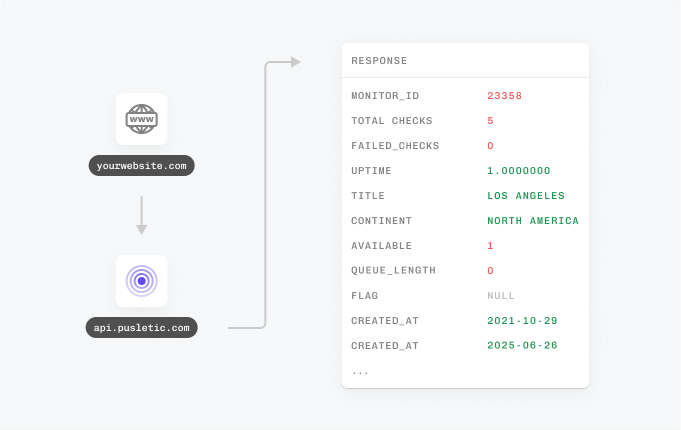
    With Pulsetic’s API, you’ve got complete control: you can add custom statistics, monitors & automations, create bespoke rules and maintain granular control over who can access or modify monitoring information. Best suited for developers in scale-up or large enterprises.

FAQ: Website Monitoring

  • What is website monitoring?

    Website monitoring is an outside service that loads your website at a fixed interval and records what it finds. If a check fails or the page gets slow, you are told about it. It is the difference between learning your website is down from a dashboard and learning it from a customer.

  • How often does Pulsetic check my website?

    Every 5 minutes on the free plan, every 60 seconds on Solo at $9 and every 30 seconds from the Team plan at $19. The interval is set per monitor, so a checkout page and a marketing page do not have to be checked at the same rate.

  • Does Pulsetic check from more than one location?

    Yes, and it matters more than the raw number of regions. When a check fails, the failure is confirmed from other regions before an alert goes out, so a route that breaks between one data center and your server never reaches your phone. Region checks are included on every plan: 3 on Free, 5 on Solo and 15 on Team.

  • How will I be told my website is down?

    By email, SMS, phone call, Telegram, Slack, Discord or Microsoft Teams, and through Zapier and webhooks for anything else. Phone calls always come from the same number, so you can save it as a contact and let it ring through Do Not Disturb. SMS and voice alerts are included on every paid plan.

  • What can website monitoring catch besides downtime?

    An expiring SSL certificate, a domain about to lapse, a page that returns 200 with the content missing, a slow region, a cron job that stopped running, and a port or service that stopped accepting connections. Each of those takes a website down in practice long before anything returns a 500.

  • Do I need to install anything on my website?

    No. Checks run from outside, against your public URL, which is the point: if your server is unreachable, monitoring that lives on the server is unreachable too. Paste a URL and the first check runs right away. Real user monitoring is the one optional exception, since it needs a small script on the page to record what real visitors experienced.

  • Is there a free website monitoring plan?

    Yes, with no time limit and no credit card. The free plan covers 10 monitors, 3 status pages on your own domain, SSL monitoring, real user monitoring, region checks and 3 months of history, and it is cleared for commercial use, so a business site can stay on it.

  • Can I show my uptime to customers?

    Yes. Every plan includes status pages on your own domain. From Solo up you can brand them with your logo and colors, password-protect an internal one, let visitors subscribe to be emailed as an incident opens, updates and resolves, and embed a status badge showing the current state anywhere on your site.