-
Need an incident.io

alternative?Try Pulsetic. Know you’re down before anyone opens an incident - for a fraction of the price.
No credit
card required.
$HTTP_PROTOCOL = (isset($_SERVER['HTTPS']) && ($_SERVER['HTTPS'] == 'on' || $_SERVER['HTTPS'] == 1)) || (isset($_SERVER['HTTP_X_FORWARDED_PROTO']) && $_SERVER['HTTP_X_FORWARDED_PROTO'] == 'https') ? 'https://' : 'http://'; $SITE_URL = $HTTP_PROTOCOL . $_SERVER['SERVER_NAME'] . '/'; ?>
Try Pulsetic. Know you’re down before anyone opens an incident - for a fraction of the price.
incident.io is built for coordinating response teams in Slack once an incident is underway. It doesn’t detect outages itself; it relies on monitoring tools like Datadog or Grafana to raise the alarm.
Pulsetic starts one step earlier. It monitors your websites from 15 locations around the world, alerts you the moment something goes down, and keeps your customers informed with beautiful status pages - in every language.
And there’s another reason people searching for an incident.io alternative land on Pulsetic: you pay one flat price, not per seat.
Let's compare the two.
Uptime monitoring built in
incident.io doesn’t check whether your website is up; it ingests alerts from monitoring tools you buy separately. Pulsetic does the detection itself, with checks down to every 30 seconds from 15 global locations. One tool, not two.
Beautiful status badges
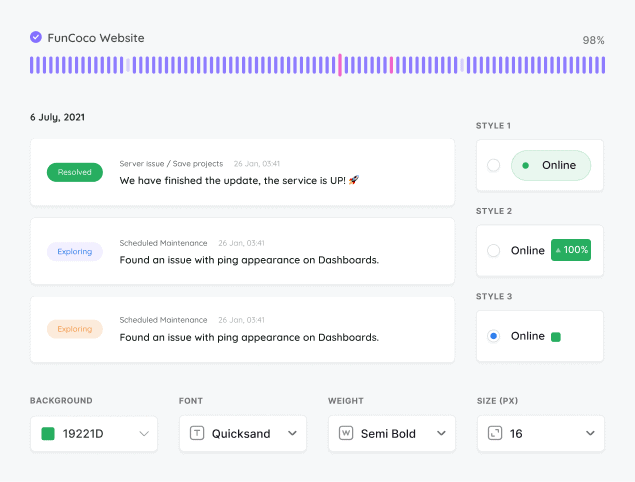
incident.io offers no embeddable status badge, only a JSON widget API so you can build your own. Pulsetic gives you a white-labeled badge showing your availability in real time on any page you like, customizable to your brand in minutes: colors, fonts, text and backgrounds, or full Custom CSS.
Support for every language
incident.io status pages have no built-in multi-language support, and custom colors aren’t available either. Pulsetic supports every language on earth, from Spanish to Swahili, so wherever your customers are, you can tell them what’s happening in their own words.
“Pulsetic is super easy to use and fast. The UI is very simple and clean, and it offers all the right features. The status page design is also great, and we really liked the fact that we could set up alert notifications in multiple channels (SMS/calls, email, slack, webhooks etc.)”
Akis
Trustpilot
Free plans
incident.io’s free Basic plan gives you Slack or Teams incident response, one on-call schedule, one public status page and one workflow - but no monitoring, so you still don’t know when you’re down. Pulsetic’s free plan covers the whole job: uptime monitors plus full-featured status pages with custom domains.
Per seat vs flat price
incident.io starts at $15 per user per month billed annually ($19 monthly), and on-call paging is a separate add-on at about $10 more per user. Pulsetic’s alternative to incident.io is $9/month flat: monitoring, status pages, badges and alerts, with no seat math and no add-ons.
Team plans
Five responders on incident.io’s cheapest paid tier with on-call run about $125/month, before you’ve paid for any monitoring underneath. Pulsetic’s Team plan starts at $19/month with 100 SMS and voice-call alert credits, teammates and the monitoring included.
incident.io
Free plan / trial
Free Plan
Free Plan
Price (USD/mo)
$9
$15/user
Monitoring
Check time
30 sec
n/a
Choice of regional data centers
✕
SSL monitoring
✕
Keyword monitoring
✕
Ping / ICMP monitoring
✕
Port monitoring
✕
TCP monitoring
✕
Domain monitoring
✕
Cron / heartbeat monitoring
Custom HTTP requests
✕
Customized responses
✕
API
MCP server
n8n integration
✕
Monitoring data retention
5 yr
n/a
Status Pages
Incident updates
Status updates for subscribers via email
Maintenance windows
Status badges
✕
Customized domain
Customized colors
✕
Customized logo
Remove branding
✕
Customized status page layout
✕
CSS customization
✕
Custom email sender & templates
✕
AI writing assistant
Page translations
✕
Password-protected status page
✕
Notifications
Email alerts
SMS alerts
Phone call alerts
Slack alerts
MS teams alerts
Discord alerts
✕
Telegram alerts
✕
Mattermost alerts
✕
Webhooks alerts
Zapier alerts
Twilio alerts
✕
Datadog integration
Integration with SIGNL4
✕
Analytics
See response times
✕
Response time by location
✕
Custom date range reports
Scheduled email reports
Security
Two-factor authentication
✕
Single Sign-On (SAML)
Role-based access
Support
Chat
Human Support
AI Support
✕
Helpdesk Articles
Email Support
Comparison based on publicly available information as of June 2026. Features and pricing change frequently, so please verify current details on each provider’s website.
See where your website is loading slowly
We’ll check your website response times from different locations around the world, so you know if there’s an issue in a particular region.
Alerts wherever you want them
Pulsetic lets you know the moment your website is down, through Slack, Telegram groups, Webhooks, email, SMS or voice call.
Never let your SSL expire again
We’ll let you know when it’s time to update your SSL certificate - so you can renew it before customers are seeing error messages.
2-minute setup · Cancel any time
No credit card needed
No. incident.io runs no uptime checks of its own: no HTTP, SSL, ping, port, TCP or domain monitoring from any location. It is an on-call and incident response layer that ingests alerts from external monitoring tools like Datadog, Prometheus or Grafana. The one exception is passive heartbeat monitoring for cron jobs on paid On-call plans. To actually detect an outage you still need a separate monitoring tool. Pulsetic is that tool, and it includes status pages too: it checks your websites as often as every 30 seconds from 15 locations worldwide.
The advertised price is $15 per user per month billed annually ($19 monthly), but on-call paging is a separate add-on at roughly $10 per user per month, and viewer seats convert to paid responder seats the moment someone acts on an incident. Five responders with on-call come to about $125 per month, and you still have not paid for the monitoring tool that detects outages. Pulsetic starts at $9 per month flat, monitoring included.
Yes. The free Basic plan includes Slack or Microsoft Teams incident response, one on-call schedule, one public status page and one workflow. What it does not include is any uptime monitoring, so on the free plan you still need another product to know when you are down. Pulsetic's free plan covers both jobs: uptime monitors and full-featured status pages in one tool.
Only lightly. You can set a logo, favicon and custom domain, and pick light or dark mode. Custom colors, layout changes, CSS and removing the incident.io footer branding are explicitly unavailable, and there is no built-in multi-language support. Pulsetic status pages support custom colors, logos, layouts, CSS, your own domain, full white labeling and translations into any language.
It depends on the job. incident.io is excellent at coordinating large incident response teams in Slack. But if what you need is to know when your website goes down and to tell your customers about it, Pulsetic covers exactly that for $9 per month flat: uptime monitoring from 15 locations, alerts by phone call, SMS, email, Slack and more, plus customizable status pages and badges. No per-seat pricing, no add-ons.
Reviewers rate incident.io highly, around 4.8 out of 5 on G2, but the recurring complaints are cost and fit: the real price climbs well past the sticker price once on-call is added, and the product is built for orchestrating many responders across big organizations. Small teams usually need detection first, coordination later. Pulsetic gives you the detection and customer communication for a flat price, and you can add an incident response platform when you genuinely outgrow it.
Yes. incident.io is designed to receive alerts from monitoring tools through its alert sources, and Pulsetic can send webhook alerts when a monitor goes down. So Pulsetic can be the detection layer that triggers incident.io's response workflows. Many teams find that Pulsetic's own alerting and status pages cover them well before they need a dedicated incident coordination product on top.
Yes. Recreate your components as Pulsetic monitors, point your custom domain at the new page and invite your subscribers. You immediately gain things incident.io's pages cannot do: custom colors and layouts, CSS control, full white labeling, translations and embeddable status badges, plus the page updates itself because Pulsetic does the monitoring. If you need help with the move, the support team will walk you through it.
Stay online, all the time, with Pulsetic's uptime prime.
By Designmodo
MONITORING
STATUS
SERVICE
COMPARE
ACCOUNT