• Need a PagerDuty underline
    alternative?

    Try Pulsetic. Monitoring, phone alerts and status pages from $9 flat - not per user.

    Learn why...

    No credit
    card required.

  • Looking for a PagerDuty alternative?

Pulsetic vs PagerDuty: the breakdown

PagerDuty’s reputation is earned: when an alert fires, the page arrives, and 900+ reviewers rate it among the best incident platforms in the business.

But it solves a big-company problem at a big-company price. It charges per user, runs no checks of its own, and the loudest complaint in every review channel is the bill.

That’s why people searching for a PagerDuty alternative land on Pulsetic: detection, phone and SMS alerts and a status page, in one flat-price tool.

Let’s compare the two.

  • Detection included, not outsourced

    Detection included, not outsourced

    PagerDuty waits for your monitoring tools to raise alerts; even cron heartbeats need the paid AIOps add-on. Pulsetic does the checking itself, from up to 15 locations as often as every 30 seconds, then pages you.

  • Status pages on every paid plan

    Status pages on every paid plan

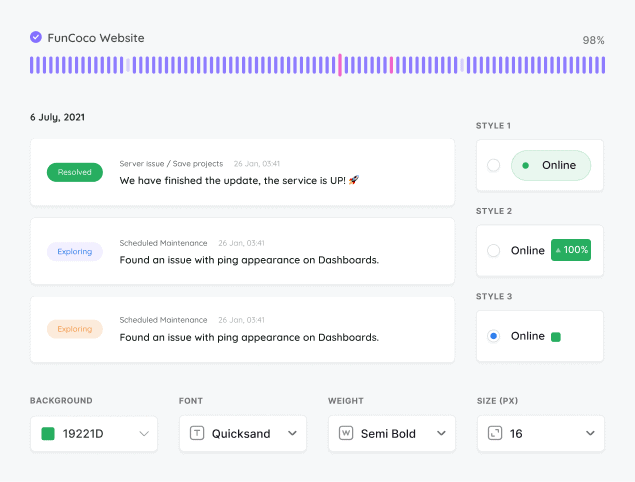
    PagerDuty gates status pages by tier and caps them: none on Free, 250 subscribers on Professional, private pages on Business and up. Pulsetic includes customizable pages with subscriber emails and badges from $9.

  • A price that ignores headcount

    A price that ignores headcount

    Five responders on PagerDuty Professional run $105/month, and the add-ons climb from there: AIOps from $699, the AI assistant from $415. Pulsetic’s plans are $9 to $49 flat, with no per-responder meter.

  • “Pulsetic is super easy to use and fast. The UI is very simple and clean, and it offers all the right features. The status page design is also great, and we really liked the fact that we could set up alert notifications in multiple channels (SMS/calls, email, slack, webhooks etc.)”

  • Review person

    Akis

    Trustpilot

Pricing: Pulsetic vs PagerDuty

  • Free plans

    PagerDuty’s free plan covers 5 users but allows just one schedule, one escalation policy and 100 SMS/phone alerts a month, with no status pages at all. Pulsetic’s free plan brings 10 monitors plus status pages on custom domains.

  • Per user vs flat

    PagerDuty Professional is $21 per user per month billed annually, so five responders start at $105, before the separate monitoring tool it depends on. Pulsetic’s alternative to PagerDuty is $9/month flat with the monitoring built in.

  • Team plans

    Stakeholder seats, private status pages and AI features all push PagerDuty toward Business at $41 per user and beyond. Pulsetic’s Team plan is $19/month with teammates, role-based access and 100 SMS and voice-call credits included.

Feature comparison

PulseticPulsetic

PagerDuty

Free plan / trial

Free Plan

Free Plan (5 users)

Price (USD/mo)

$9

$21/user

Monitoring

Check time

30 sec

n/a

Choice of regional data centers

SSL monitoring

Keyword monitoring

Ping / ICMP monitoring

Port monitoring

TCP monitoring

Domain monitoring

Cron / heartbeat monitoring

DIY via add-on

Custom HTTP requests

Customized responses

API

MCP server

n8n integration

Monitoring data retention

Up to 5 yr

n/a

Status Pages

Incident updates

Status updates for subscribers via email

Maintenance windows

Status badges

Customized domain

Customized colors

Customized logo

Remove branding

Customized status page layout

CSS customization

Custom email sender & templates

Sender domain only

AI writing assistant

$415/mo add-on

Page translations

Password-protected status page

Business plan and up

Notifications

Email alerts

SMS alerts

Phone call alerts

Slack alerts

MS teams alerts

Discord alerts

Telegram alerts

Mattermost alerts

Webhooks alerts

Zapier alerts

Twilio alerts

Datadog integration

Integration with SIGNL4

Analytics

See response times

Response time by location

Custom date range reports

Incidents only

Scheduled email reports

Security

Two-factor authentication

Single Sign-On (SAML)

Role-based access

Support

Chat

Premium support only

Human Support

AI Support

Helpdesk Articles

Email Support

Comparison based on publicly available information as of June 2026. Features and pricing change frequently, so please verify current details on each provider’s website.

And there’s more in Pulsetic’s free plan…

  • See where your website is loading slowly

    See where your website is loading slowly

    We’ll check your website response times from different locations around the world, so you know if there’s an issue in a particular region.

  • Alerts wherever you want them

    Alerts wherever you want them

    Pulsetic lets you know the moment your website is down, through Slack, Telegram groups, Webhooks, email, SMS or voice call.

  • Never let your SSL expire again

    Never let your SSL expire again

    We’ll let you know when it’s time to update your SSL certificate - so you can renew it before customers are seeing error messages.

Frequently asked questions

  • Does PagerDuty monitor uptime?

    No. PagerDuty runs no uptime checks of its own: no HTTP, SSL, keyword, ping, port, TCP or domain monitoring appears anywhere in its pricing or docs. It ingests alerts from external monitoring tools through its Events API and 750+ integrations, and its own blog points readers to partner products for URL monitoring. Even heartbeat monitoring for cron jobs is a do-it-yourself pattern that requires the paid AIOps add-on. Pulsetic is the detection side in one tool: checks from up to 15 locations, with phone, SMS, email and Slack alerts built in.

  • How much does PagerDuty actually cost?

    Professional is $21 per user per month billed annually ($25 monthly) and Business is $41 ($49 monthly). A 5-person on-call team starts at $105 per month, or $205 on Business if it needs the higher status-page caps or stakeholder users. The add-ons are where budgets go sideways: AIOps alert-noise reduction starts at $699 per month, the Advance AI assistant has been quoted at $415 per month, and stakeholder licenses and extra status page capacity are contact-sales items. Pulsetic is $9 to $49 per month flat, monitoring included.

  • Is PagerDuty's free plan enough for a small team?

    It covers up to 5 users but is capped at 1 on-call schedule, 1 escalation policy and 100 SMS or phone notifications per month, with no SSO and no status pages of any kind. Real rotations outgrow it quickly; it works best as an on-ramp to the per-user tiers. Pulsetic's free plan approaches it from the monitoring side: 10 monitors, status pages and custom domains, free for commercial use.

  • What are PagerDuty's status pages like?

    Tier-gated and capacity-capped. The free plan has none; Professional includes one public page with up to 250 subscribers; private pages start at the Business tier, sold as a premium status-page package, and subscribers rise to 500; Enterprise reaches 1,000, with more capacity sold separately. Pages support a custom domain, logo and color palette, but custom CSS, layout control, branding removal, badges and translations are not documented, and posting is rate-limited. Pulsetic includes customizable status pages with subscriber notifications on every paid plan, starting at $9 per month.

  • Is PagerDuty overkill for a small team?

    Reviewers rate it highly, around 4.5 out of 5 on G2 from more than 900 reviews, and its alert delivery is famously dependable. But the top complaint on every channel is price, the second is complexity, and comparison write-ups commonly put the cutoff around 15 engineers: below that, per-user incident-management rates buy features most teams never touch. If your actual need is to know when your website goes down, alert the right person and show customers a status page, a monitoring-first tool covers it for a flat price.

  • Can Pulsetic and PagerDuty work together?

    Yes. PagerDuty is built to receive alerts from monitoring tools, and Pulsetic can send webhook alerts the moment a check fails, so Pulsetic can act as the detection layer that triggers PagerDuty's escalation machinery. Plenty of teams run exactly that pair, and plenty more find that Pulsetic's own phone, SMS and chat alerting covers them without a second subscription.

  • What does PagerDuty have that Pulsetic does not?

    Deep incident orchestration: complex escalation policies, multi-team schedules, stakeholder communications, postmortems, event automation and enterprise compliance, plus an official MCP server, Terraform provider and a huge integration directory. If you are running incident command across hundreds of services and responders, that machinery earns its price. Pulsetic deliberately solves a smaller, more common problem: detect downtime, alert fast, keep customers informed, at a price a small team does not have to justify.

  • When should I switch from PagerDuty to Pulsetic?

    The usual triggers: the renewal quote climbed again; you are paying per user for a tool most of the team barely opens; you still had to buy separate monitoring because PagerDuty detects nothing on its own; or the status page you need sits a tier above your budget. Pulsetic folds detection, phone and SMS alerts and a customizable status page into flat plans, and your PagerDuty webhooks can stay wired up during the transition.

Hey there 👋  Friends from designmodo are here to help!