-
Need a Cachet
alternative?Try Pulsetic. A status page with the monitoring built in - and no server to run.
No credit
card required.
$HTTP_PROTOCOL = (isset($_SERVER['HTTPS']) && ($_SERVER['HTTPS'] == 'on' || $_SERVER['HTTPS'] == 1)) || (isset($_SERVER['HTTP_X_FORWARDED_PROTO']) && $_SERVER['HTTP_X_FORWARDED_PROTO'] == 'https') ? 'https://' : 'http://'; $SITE_URL = $HTTP_PROTOCOL . $_SERVER['SERVER_NAME'] . '/'; ?>
Try Pulsetic. A status page with the monitoring built in - and no server to run.
Cachet earned its reputation: the original open-source status page, self-hosted, fully white-labeled and free. Plenty of serious companies have run it.
But it’s a communication layer only. Cachet runs no checks, so nothing on the page changes until you or your scripts call its API. And as of mid-2026 its production release dates from 2023, while the long-awaited v3 rewrite hasn’t shipped.
That’s why people searching for a Cachet alternative land on Pulsetic: detection and the status page in one hosted tool, with nothing to maintain.
Let’s compare the two.
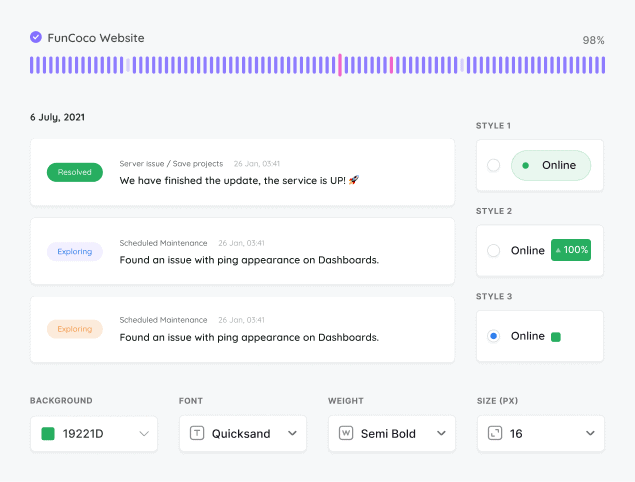
A status page that updates itself
Cachet waits for a human or a script to report trouble through its API. Pulsetic does its own detection, checking from 15 locations worldwide, and reflects an outage on your status page without anyone lifting a finger.
Subscribers and badges, today
Email subscriptions, status badges and 2FA shipped in Cachet v2, but the v3 rewrite doesn’t have them yet. Pulsetic includes subscriber notifications and status badges on every paid plan.
Alerts that find you
Because Cachet detects nothing, it can’t tell you anything went wrong: no downtime emails, no Slack ping, no call. Pulsetic alerts you the moment a check fails, by phone call, SMS, email, Slack, Telegram or webhook.
“Pulsetic is super easy to use and fast. The UI is very simple and clean, and it offers all the right features. The status page design is also great, and we really liked the fact that we could set up alert notifications in multiple channels (SMS/calls, email, slack, webhooks etc.)”
Akis
Trustpilot
Free vs free
Cachet’s software costs nothing, and then the stack begins: a VPS, PHP and a database, a cron job, SSL and backups. Pulsetic’s free plan is hosted, with monitors, a status page and a custom domain included outright.
The real cost
With Cachet you maintain a Laravel app, and you still need a separate monitoring tool to feed it. Pulsetic’s alternative to Cachet is $9/month flat, with the detection, the page and the upkeep all covered.
Team plans
Cachet offers two roles, Admin and User, and the rest of the access story is up to your server setup. Pulsetic’s Team plan starts at $19/month with teammates, role-based access and 100 SMS and voice-call alert credits included.
Cachet
Free plan / trial
Free Plan
Free (open source)
Price (USD/mo)
$9
$0 + your server
Monitoring
Check time
30 sec
n/a
Choice of regional data centers
✕
SSL monitoring
✕
Keyword monitoring
✕
Ping / ICMP monitoring
✕
Port monitoring
✕
TCP monitoring
✕
Domain monitoring
✕
Cron / heartbeat monitoring
✕
Custom HTTP requests
✕
Customized responses
✕
API
MCP server
✕
n8n integration
✕
Monitoring data retention
5 yr
n/a
Status Pages
Incident updates
Status updates for subscribers via email
v2 only, not in v3
Maintenance windows
Status badges
v2 only
Customized domain
Customized colors
Customized logo
Remove branding
Customized status page layout
Limited
CSS customization
Custom email sender & templates
✕
AI writing assistant
✕
Page translations
Password-protected status page
✕
Notifications
Email alerts
✕
SMS alerts
✕
Phone call alerts
✕
Slack alerts
✕
MS teams alerts
✕
Discord alerts
✕
Telegram alerts
✕
Mattermost alerts
✕
Webhooks alerts
Page events only
Zapier alerts
✕
Twilio alerts
✕
Datadog integration
✕
Integration with SIGNL4
✕
Analytics
See response times
Push via API only
Response time by location
✕
Custom date range reports
✕
Scheduled email reports
✕
Security
Two-factor authentication
v2 only
Single Sign-On (SAML)
✕
Role-based access
Admin/User only
Support
Chat
✕
Human Support
Community only
AI Support
✕
Helpdesk Articles
Email Support
✕
Comparison based on publicly available information as of June 2026. Features and pricing change frequently, so please verify current details on each provider’s website.
See where your website is loading slowly
We’ll check your website response times from different locations around the world, so you know if there’s an issue in a particular region.
Alerts wherever you want them
Pulsetic lets you know the moment your website is down, through Slack, Telegram groups, Webhooks, email, SMS or voice call.
Never let your SSL expire again
We’ll let you know when it’s time to update your SSL certificate - so you can renew it before customers are seeing error messages.
2-minute setup · Cancel any time
No credit card needed
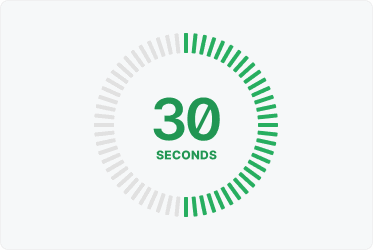
No. Cachet performs no checks of any kind: no HTTP, SSL, keyword, ping, port or heartbeat monitoring. It is a communication layer, and its own homepage tells you to hook your monitoring tools into its API. Components and incidents only change when a person or an external script updates them, which is why a whole ecosystem of third-party sidecars exists just to bolt detection onto it. Pulsetic does both jobs in one tool: it checks your websites as often as every 30 seconds from 15 locations and updates your status page automatically.
The software is free and open source, funded by sponsors. The running costs are yours, though: a server, a PHP 8.2+ and Laravel stack with a database, a cron job, SSL and backups, plus the hours to set it up and keep it patched. One licensing detail worth knowing: the classic v2 is MIT, while the v3 rewrite uses a more restrictive source-available license that forbids redistributing Cachet as a standalone product. Pulsetic has a free hosted plan, and paid plans start at $9 per month with no infrastructure to run.
Yes, with an asterisk. After years of dormancy, the original creator took the project back and announced a revival in 2023, shipping v2.4 to close out the legacy branch. Development of the v3 rewrite is genuinely active, but as of mid-2026 it has no tagged release and the docs describe it as not production-ready, while v2.4 from late 2023 remains the only production version and is officially unsupported. You can run Cachet today, but you are choosing between an unsupported release and an unreleased one.
On v2, yes: email subscriptions were a headline feature. The v3 rewrite does not support subscribers yet, and the same goes for the embeddable status badges and two-factor authentication that v2 shipped. Until v3 catches up, those features exist only on the legacy branch. Pulsetic status pages include subscriber notifications and embeddable badges on every paid plan, starting at $9 per month.
No, because it never knows. Cachet runs no checks, so it has no concept of your website being down: there are no email, SMS, Slack or phone alerts for outages, and the v3 webhooks fire on status page events you create, not on downtime it detects. Pulsetic detects the outage itself and alerts you by phone call, SMS, email, Slack, Telegram, webhooks and more, then updates your status page automatically.
Genuinely customizable, which is part of its appeal: theme colors with light and dark modes, a dedicated custom CSS setting, custom header and footer HTML, free branding removal, more than a dozen languages and your own domain by virtue of self-hosting. The overall layout is fixed beyond component ordering. Pulsetic gives you comparable control, with colors, logos, layouts, CSS and full white labeling, on a page we host and keep up for you.
A server with PHP 8.2+ and Composer, a database, a cron job for the queue, a web server with SSL, and a backup routine. Setup takes a few hours and maintenance is ongoing: OS and framework updates, security patches and capacity planning. There is also the classic catch: the status page must live on separate, more reliable infrastructure than the things it reports on, or it goes down with them. With Pulsetic there is nothing to host at all.
Pick Pulsetic when you want detection and communication in one tool: monitoring from 15 locations, alerts the moment something breaks, and a status page with subscriber emails and badges that works today, hosted on infrastructure that stays up when yours does not. Cachet remains a fine choice if you enjoy self-hosting, already run monitoring elsewhere and have the ops time to maintain a Laravel app. If the status page is meant to reassure customers during your worst hour, hosting it yourself is the one place you do not want a single point of failure.
Stay online, all the time, with Pulsetic's uptime prime.
By Designmodo
MONITORING
STATUS
SERVICE
COMPARE
ACCOUNT