Uptime Monitoring for Hosting Providers

Your customers’ websites live on your infrastructure, and they notice the second it blinks. Pulsetic watches your servers, services and client websites from 15 locations, with a branded status page that answers “is it down?” before the ticket gets written.

* No credit card required

Made for You

  • Every server, every service

    Ping checks confirm hosts are reachable, port and TCP checks watch SMTP, IMAP, SSH, FTP, DNS and databases, and HTTP checks cover control panels and the websites you host.

  • A status page that deflects tickets

    During an incident, customers who see an acknowledged issue wait; customers in the dark open tickets. A branded status page at status.yourhost.com, subscriber emails and maintenance windows keep them informed.

  • Uptime you can prove

    Hosting is sold on uptime promises. SLA monitoring with custom date ranges, scheduled email reports and response times by region turns “trust us” into independent numbers.

"Tens of thousands of business owners from around the world rely on our service, and Pulsetic is the best platform there is to ensure we communicate any downtimes clearly and swiftly to our customers to avoid panic and disappointment. Getting setup on Pulsetic not only been smooth and easy but super joyful too, the design is stunning and customisable unlike any other monitoring platform we’ve used."

Leo Bassam
Leo Bassam

Founder, CEO at Plutio

"There's an easy way for you to monitor your online project. After all the hard work you have put into going live, you want to make sure that things keep running smoothly while you focus on the next project."

Chris Kalmar
Chris Kalmar

Founder at nineLemon

"Pulsetic is super easy to use and fast. The UI is very simple and clean, and it offers all the right features. The status page design is also great, and we really liked the fact that we could set up alert notifications in multiple channels."

Akis Laopodis
Akis Laopodis

Founder of HelpfulDocs

"The monitoring tool we've been waiting for. Super easy to set up monitoring, customizable status page design, and access to notifications across Slack, email and SMS. Pulsetic is awesome."

Andrei Negrau
Andrei Negrau

CEO at Cartloop.io

"Pulsetic helps us monitor all of our websites and webapps over at Pairing.dev. Before we used it, we had no idea how often services (e.g. heroku) were offline. Now we have complete control over it."

Till Carlos
Till Carlos

Founder at Pairing.dev

"Using Pulsetic is a big win for us! Our dev team can now deliver faster, with zero time spent monitoring our website uptime. Plus the interface is great and analytics proper."

Razvan Popescu
Razvan Popescu

Head of Marketing at AbstractAPI

Watch the Entire Stack

  • Web servers and panels

    HTTP and HTTPS checks watch customer websites, webmail and control panels, and keyword monitoring verifies pages render content instead of a blank 200.

  • Mail services

    Port monitoring on SMTP, IMAP and POP3 catches a dead mail daemon early, the failure customers report angriest and last.

  • DNS and domains

    Port checks confirm nameservers answer, and domain monitoring watches expirations across your brand domains and resellers’ names.

  • Databases and services

    TCP monitoring confirms MySQL, PostgreSQL and any custom daemon is accepting connections, whatever port it is bound to.

  • Backups and maintenance

    Heartbeat monitoring expects a ping from every backup and maintenance job, so a silently failing backup gets loud before restore day.

  • SSL across the fleet

    SSL monitoring reminds you 14, 7 and 1 days before certificates expire, across every domain you are responsible for.

And tell customers before they ask

Publish a status page on your own domain with subscriber notifications, and embed status badges in your client area so the answer to “is it down?” is always one glance away.

How Does It Work for a Hosting Provider?

Minutes to set up by hand, or scripted into your provisioning flow.

  • Add your servers, services and key customer websites, by hand or through the API on Team plans.

  • Publish your branded status page and point alerts at Slack, SMS, phone or webhooks into on-call tooling.

  • Run your infrastructure. Multi-location checks confirm an incident is real before on-call gets paged.

  • For System Administrators

    Watch ping, ports and services across every server you run, with heartbeat checks on backups and maintenance jobs.

  • For IT Managers

    Prove delivered uptime with scheduled reports and per-monitor history, independent of your own server logs.

  • For Webmasters

    Monitor every client website you host from one dashboard and catch issues before the support queue does.

  • For Business Owners

    Protect the reputation your hosting brand is built on: catch downtime first and keep customers informed.

  • Bring in your whole team.

    Need access for more than one person? Pulsetic is for you. Easily manage access controls with specific rights and permissions for individual users, so you can collaborate without compromising on security.

  • Team access
  • API
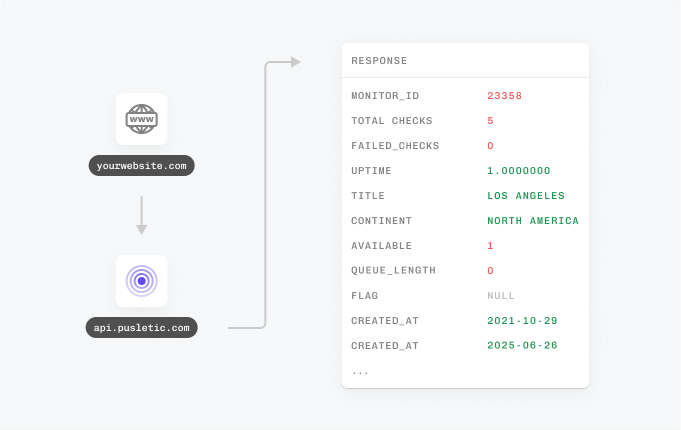
  • Connect your API for even more flexibility.

    With Pulsetic’s API, you’ve got complete control: you can add custom statistics, monitors & automations, create bespoke rules and maintain granular control over who can access or modify monitoring information. Best suited for developers in scale-up or large enterprises.

FAQ: Monitoring for Hosting Providers

  • Can Pulsetic monitor mail servers and other services?

    Yes. Port and TCP checks watch anything that listens on a port reachable from the internet: SMTP, IMAP and POP3 for mail, SSH, FTP, DNS and databases. Ping checks confirm the host itself is reachable, and HTTP checks cover control panels, webmail and every website you host.

  • How many monitors can a hosting provider run?

    The Organization plan includes 300 monitors at $49 per month, and extra monitors cost $0.20 each, so the fleet can grow with you. Most providers monitor shared infrastructure per node plus their most important customer endpoints rather than literally every account, which keeps the count practical.

  • Does a status page actually reduce support tickets?

    During an incident, customers who can see an acknowledged issue with updates generally wait; customers staring at a dead website open tickets. A status page at status.yourhost.com gives them somewhere to look, subscriber emails tell them proactively, and maintenance windows announce planned work before anyone mistakes it for an outage.

  • Can we white-label the status page for our brand?

    Yes. Custom domains are available on every plan including the free one, customization such as your logo and colors starts at $9 per month, and full white labeling with Pulsetic branding removed is included from the Team plan at $19 per month.

  • How do we prove the uptime we promise in our SLA?

    With independent measurement. Pulsetic keeps uptime history and response times per monitor, generates reports over custom date ranges, and emails scheduled reports automatically. When a customer questions their SLA, you answer with data from a third party rather than your own logs.

  • Can we automate monitoring for new customers?

    Yes. The REST API with its OpenAPI spec lets your provisioning flow create monitors the moment an account is activated, and the MCP server and n8n integration cover AI assistants and no-code automation. API access is included from the Team plan.

  • How do alerts reach our on-call engineers?

    Through whatever your team actually watches: Slack, Microsoft Teams, Telegram, Discord and email, with SMS and phone calls for the overnight tier, and webhooks into any incident or on-call tooling you already run. Paid plans include SMS and voice-call credits.

  • Should we monitor servers with ping or HTTP checks?

    Both, for different layers. Ping tells you the host is reachable, port checks tell you a specific daemon is accepting connections, and HTTP tells you the service actually answers correctly. Checks run from up to 15 locations, and an incident is confirmed from multiple regions before anyone is woken up.

Hey there 👋  Friends from designmodo are here to help!