-
Need a Site24x7
alternative?Try Pulsetic. The focused uptime and status page tool, without the enterprise suite you won’t use.
No credit
card required.
$HTTP_PROTOCOL = (isset($_SERVER['HTTPS']) && ($_SERVER['HTTPS'] == 'on' || $_SERVER['HTTPS'] == 1)) || (isset($_SERVER['HTTP_X_FORWARDED_PROTO']) && $_SERVER['HTTP_X_FORWARDED_PROTO'] == 'https') ? 'https://' : 'http://'; $SITE_URL = $HTTP_PROTOCOL . $_SERVER['SERVER_NAME'] . '/'; ?>
Try Pulsetic. The focused uptime and status page tool, without the enterprise suite you won’t use.
Websites go down. When that happens you need to know first, and your customers need a clear place to look. That is the whole job, and it should not require a platform built for enterprise IT teams.
Site24x7 is a broad, full-stack suite: servers, applications, networks, logs and cloud, all in one console. It is powerful, but if all you want is reliable uptime checks and a polished status page, most of that surface area is weight you carry and pay for.
Pulsetic does the website monitoring and status page job, and keeps it simple. That focus is why teams looking for a Site24x7 alternative land here.
Let’s compare the two.
30-second checks on every plan
Site24x7 checks every 60 seconds on its standard plans. Faster 30-second checks sit behind its Enterprise tiers and use extra monitor licenses each. Pulsetic runs 30-second checks by default, so you learn about an outage in half the time, with no upgrade required.
A free plan, not a 30-day clock
Site24x7 starts you on a 30-day trial and then moves you to a paid plan. Pulsetic has a genuinely free plan that allows commercial use, so you can monitor a real, revenue-generating website without a credit card and without a deadline running down.
Built for your website, not a data center
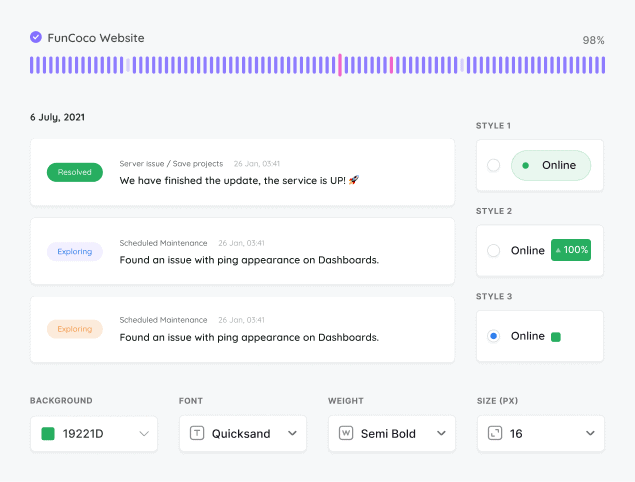
With Site24x7 you navigate a console designed for APM, server, network and log monitoring, even when you only need website checks and a status page. Pulsetic shows you exactly that: monitors, response times, alerts and a status page your customers will actually understand.
"Pulsetic has simplified our uptime monitoring significantly. We've fully automated uptime tracking and SLA reporting, which removed a lot of manual work from our monthly and annual reports. The automated downtime notifications (via Slack and email) help the team react quickly when something goes wrong. The API is especially valuable for us, as it allows us to use a dedicated health-check endpoint and integrate uptime data directly into our internal workflows."
Mariana Kodama
Treasurer, Fundacion Jorge Luis Borges
What the entry plan covers
Site24x7’s entry plan is around $9 a month and covers up to 5 websites. Pulsetic’s paid plans also start at $9, with more monitors and unlimited, fully featured status pages included. You get the customization and alert integrations without climbing tiers.
The add-ons add up
Site24x7 prices many capabilities as add-ons and uses extra monitor licenses for faster checks. Pulsetic keeps it predictable: 30-second checks plus SSL, keyword, port, TCP, domain and cron monitoring are part of the plan, not metered extras.
Status pages included
On Pulsetic, status pages are core, not a separate product line. Create as many as you need, put them on your own domain, customize the design, and notify subscribers automatically when something breaks.
Site24x7
Free plan / trial
Free Plan
30 days
Price (USD/mo)
$9
$9
Monitoring
Check time
30 sec
60 sec
Choice of regional data centers
SSL monitoring
Keyword monitoring
Ping / ICMP monitoring
Port monitoring
TCP monitoring
Domain monitoring
Cron / heartbeat monitoring
Custom HTTP requests
Customized responses
API
MCP server
n8n integration
✕
Monitoring data retention
Up to 5 yr
1 yr
Status Pages
Incident updates
Status updates for subscribers via email
Maintenance windows
Status badges
Customized domain
Customized colors
Customized logo
Remove branding
✕
Customized status page layout
✕
CSS customization
Custom email sender & templates
AI writing assistant
✕
Page translations
Password-protected status page
Notifications
Email alerts
SMS alerts
Phone call alerts
Slack alerts
MS teams alerts
Discord alerts
Telegram alerts
Mattermost alerts
✕
Webhooks alerts
Zapier alerts
Twilio alerts
✕
Datadog integration
✕
Integration with SIGNL4
✕
Analytics
See response times
Response time by location
Custom date range reports
Scheduled email reports
Security
Two-factor authentication
Single Sign-On (SAML)
Role-based access
Support
Chat
Human Support
AI Support
✕
Helpdesk Articles
Email Support
Comparison based on publicly available information as of June 2026. Features and pricing change frequently, so please verify current details on each provider’s website.
See where your website is loading slowly
We’ll check your website response times from different locations around the world, so you know if there’s an issue in a particular region.
Alerts wherever you want them
Pulsetic lets you know the moment your website is down, through Slack, Telegram groups, Webhooks, email, SMS or voice call.
Never let your SSL expire again
We’ll let you know when it’s time to update your SSL certificate - so you can renew it before customers are seeing error messages.
2-minute setup · Cancel any time
No credit card needed
Yes, especially if you want website monitoring and a status page without an enterprise observability suite around it. Pulsetic runs 30-second checks across HTTP(S), SSL, keyword, ping, port, TCP, domain, and cron or heartbeat monitoring, and includes fully customizable status pages with subscriber notifications. Site24x7 can do all of this too, but as one module inside a much larger platform built for server, application, network, and log monitoring.
Yes. Pulsetic has a free plan that allows commercial use, so you can monitor a live website without a credit card. Site24x7 starts you with a 30-day trial and then moves you to a paid plan, so a free, no-deadline starting point is one reason teams choose Pulsetic.
Both start at about $9 per month. Site24x7’s entry plan covers up to 5 websites, while Pulsetic includes more monitors at the same starting price along with unlimited, fully featured status pages. Pulsetic also keeps faster checks and core monitor types in the plan rather than charging for them as add-ons or extra monitor licenses.
Pulsetic runs checks every 30 seconds on its standard plans. Site24x7 checks every 60 seconds on its standard plans, and its faster 30-second checks are reserved for higher Enterprise tiers and consume extra monitor licenses. With Pulsetic you find out about downtime in roughly half the time without paying more.
Site24x7 is a full-stack platform covering servers, applications, networks, logs, and cloud alongside website monitoring. If you only need to know your website is up and to show customers a status page, that breadth can feel like a lot to configure and pay for. Pulsetic focuses on uptime monitoring and status pages, so the product stays simple to set up and use.
Yes. Most people re-create their monitors by entering their URLs in Pulsetic, which takes well under an hour for a typical set of websites. You set your check interval, connect your alert channels such as Slack, Microsoft Teams, email, SMS, or webhooks, and publish a status page. You can confirm everything is reporting correctly before closing your old account.
Yes. Status pages are a core part of Pulsetic, not a separate product. You can create multiple pages, host them on your own domain, customize colors, logo, and CSS, support multiple languages, protect a page with a password, and notify subscribers by email when an incident happens or maintenance is scheduled.
Pulsetic monitors HTTP and HTTPS uptime, SSL certificates, keywords on a page, ping or ICMP, ports, TCP, domain expiry, and cron or heartbeat jobs. It checks from multiple regions you can choose, shows response times by location, and alerts you through Slack, Microsoft Teams, Discord, Telegram, email, SMS, voice call, webhooks, and more.
Stay online, all the time, with Pulsetic's uptime prime.
By Designmodo
Designmodo Inc. 169 Madison Ave, #79627, New York, NY 10016, United States
Copyright © 2010-2026