• Need an
    Uptime underline Kuma underline Uptime Kuma underline
    alternative?

    Try Pulsetic. All the monitoring, none of the server maintenance - hosted for you.

    Learn why...

    No credit
    card required.

  • Looking for an Uptime Kuma alternative?

Pulsetic vs Uptime Kuma: the breakdown

Let’s be honest: Uptime Kuma is excellent. It’s free, open source and beautifully designed, and over 87,000 GitHub stars don’t lie. If you enjoy running your own stack, it’s a lovely piece of software.

But self-hosted means self-managed. Your instance checks from the one server it lives on, you do the patching and the backups, and when that server goes down, it takes your monitoring with it.

That’s why people searching for an Uptime Kuma alternative come to Pulsetic: the same monitoring instincts, hosted for you, watching from 15 locations worldwide.

Let’s compare the two.

  • Checks from 15 locations, not one

    Checks from 15 locations, not one

    An Uptime Kuma instance watches from wherever you installed it, so one routing hiccup along the way can mean a false alarm in the middle of the night. Pulsetic verifies from 15 vantage points worldwide before it wakes you up.

  • Status pages your customers can follow

    Status pages your customers can follow

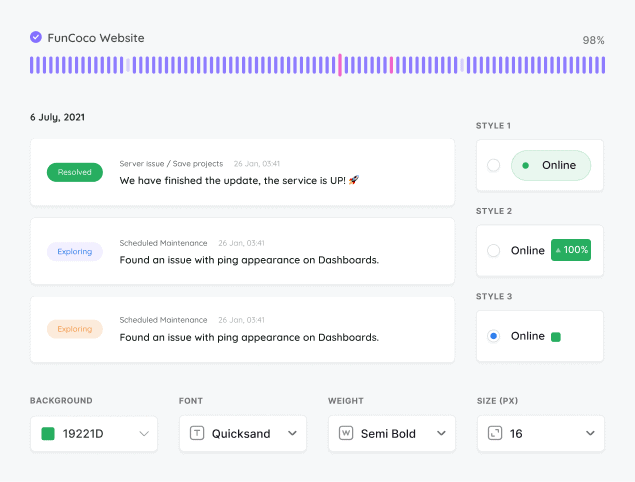
    Kuma’s status pages look great, but visitors can’t subscribe by email; that request has been open since 2021. Pulsetic pages notify subscribers automatically on incidents and recoveries, with full branding and no CSS required.

  • Nothing to host, patch or back up

    Nothing to host, patch or back up

    Docker updates, reverse proxies, TLS renewals, database backups before every upgrade: with Kuma, you’re the sysadmin. With Pulsetic there’s no server at all, and your monitoring stays up even when your infrastructure doesn’t.

  • “Pulsetic is super easy to use and fast. The UI is very simple and clean, and it offers all the right features. The status page design is also great, and we really liked the fact that we could set up alert notifications in multiple channels (SMS/calls, email, slack, webhooks etc.)”

  • Review person

    Akis

    Trustpilot

Pricing: Pulsetic vs Uptime Kuma

  • Free vs free

    Uptime Kuma’s software is genuinely free; the VPS it runs on is not, and neither is your time. Pulsetic’s free plan is hosted: monitors, status pages and custom domains with no server to rent and nothing to install.

  • The real cost

    A small VPS runs $4 to $6 a month, and then comes the labor: initial setup, ongoing updates and a growing database to look after. Pulsetic’s alternative to Uptime Kuma is $9/month flat, maintained by us, monitored from 15 locations.

  • Team plans

    Kuma has one admin account, so teams share a single login with no roles or audit trail. Pulsetic’s Team plan starts at $19/month with teammates, role-based access and 100 SMS and voice-call alert credits included.

Feature comparison

PulseticPulsetic

Uptime Kuma

Free plan / trial

Free Plan

Free (open source)

Price (USD/mo)

$9

$0 + your server

Monitoring

Check time

30 sec

20 sec

Choice of regional data centers

SSL monitoring

Keyword monitoring

Ping / ICMP monitoring

Port monitoring

TCP monitoring

Domain monitoring

RDAP TLDs only

Cron / heartbeat monitoring

Custom HTTP requests

Customized responses

API

No official REST API

MCP server

Unofficial only

n8n integration

Via webhooks

Monitoring data retention

5 yr

Configurable

Status Pages

Incident updates

Status updates for subscribers via email

Maintenance windows

Status badges

Customized domain

Customized colors

Via custom CSS

Customized logo

Remove branding

Customized status page layout

Limited

CSS customization

Custom email sender & templates

AI writing assistant

Page translations

Browser locale only

Password-protected status page

Notifications

Email alerts

SMS alerts

Via paid gateways

Phone call alerts

Slack alerts

MS teams alerts

Discord alerts

Telegram alerts

Mattermost alerts

Webhooks alerts

Zapier alerts

Via webhook

Twilio alerts

SMS only

Datadog integration

Integration with SIGNL4

Analytics

See response times

Response time by location

Custom date range reports

Scheduled email reports

Security

Two-factor authentication

Single Sign-On (SAML)

Role-based access

Support

Chat

Human Support

Community only

AI Support

Helpdesk Articles

GitHub wiki

Email Support

Comparison based on publicly available information as of June 2026. Features and pricing change frequently, so please verify current details on each provider’s website.

And there’s more in Pulsetic’s free plan…

  • See where your website is loading slowly

    See where your website is loading slowly

    We’ll check your website response times from different locations around the world, so you know if there’s an issue in a particular region.

  • Alerts wherever you want them

    Alerts wherever you want them

    Pulsetic lets you know the moment your website is down, through Slack, Telegram groups, Webhooks, email, SMS or voice call.

  • Never let your SSL expire again

    Never let your SSL expire again

    We’ll let you know when it’s time to update your SSL certificate - so you can renew it before customers are seeing error messages.

Frequently asked questions

  • Is Uptime Kuma really free?

    The software is, genuinely: Uptime Kuma is MIT-licensed open source with no paid tiers or feature gates. What you pay for is everything around it: a VPS to run it on (typically $4 to $6 per month), plus the time to set up Docker, a reverse proxy and TLS, and then to keep the instance updated, backed up and secure. Pulsetic flips that trade: a free plan and paid plans from $9 per month, with the hosting, redundancy and maintenance done for you.

  • Does Uptime Kuma check from multiple locations?

    No. One Uptime Kuma instance checks from exactly one place: the server it is installed on. Multi-region probing has been one of its most requested features for years, and the common workaround is running several independent instances and keeping their configs in sync by hand. Pulsetic checks from 15 locations around the world out of the box, so a network blip near your server does not page you at 3am for an outage your users never saw.

  • What happens when the server running Uptime Kuma goes down?

    Your monitoring goes down with it, silently: no checks, no alerts, no status page. That is the classic who-monitors-the-monitor problem, and solving it properly means running Kuma on separate infrastructure from what it watches, or running a second monitor to watch the first. Pulsetic is hosted and redundant, so it keeps watching your websites even when your own infrastructure is having its worst day, which is exactly when you need monitoring most.

  • Can visitors subscribe to an Uptime Kuma status page?

    Not by email. Email subscriptions for status page visitors have been an open feature request since 2021, so the page only informs people who think to visit it. Pulsetic status pages let your customers subscribe and get notified automatically when something goes down or recovers, which is most of the point of having a public status page.

  • Does Uptime Kuma send SMS or phone call alerts?

    Uptime Kuma's notification catalog is huge, with Slack, Telegram, Discord, Microsoft Teams, Mattermost, webhooks and dozens more. But SMS only works through paid third-party gateways like Twilio that you configure and pay separately, and there are no voice call alerts at all. Pulsetic includes SMS and phone call alerts with credits on paid plans, alongside the usual email, Slack and webhook channels.

  • Does Uptime Kuma have an API?

    There is no official REST API; it is among the most upvoted feature requests. Automation today means the internal Socket.IO interface, a couple of limited endpoints or unofficial community wrappers, and the MCP servers that exist for it are community-built rather than official. Pulsetic ships a documented REST API with an OpenAPI spec and an official MCP server, so your scripts and AI assistants can manage monitors with supported tooling.

  • Is Uptime Kuma good for teams?

    It is built around a single admin account: no roles, no SSO, no audit trail, so a team ends up sharing one login. That is fine for a homelab and risky for a business. Pulsetic supports teammates with role-based access on Team and Organization plans, so people get their own accounts with the right permissions.

  • When should I switch from Uptime Kuma to Pulsetic?

    The usual trigger is the moment monitoring becomes a chore instead of a hobby: you need multi-location verification before alerts fire, customers are asking to subscribe to your status page, you want phone alerts for real emergencies and an API to provision monitors automatically, or you simply stop wanting to patch and back up another server. Plenty of people keep Uptime Kuma for the homelab and use Pulsetic for production and customer-facing websites; the two are not mutually exclusive.

Hey there 👋  Friends from designmodo are here to help!