Uptime Monitoring for Developers

You wrote it, you shipped it, and now it has to stay up. Pulsetic watches your apps, APIs and cron jobs from 15 locations, alerts you in the channels you already live in, and stays scriptable end to end with a REST API, an MCP server and an n8n integration.

* No credit card required
Made for You

  • Monitoring that speaks code

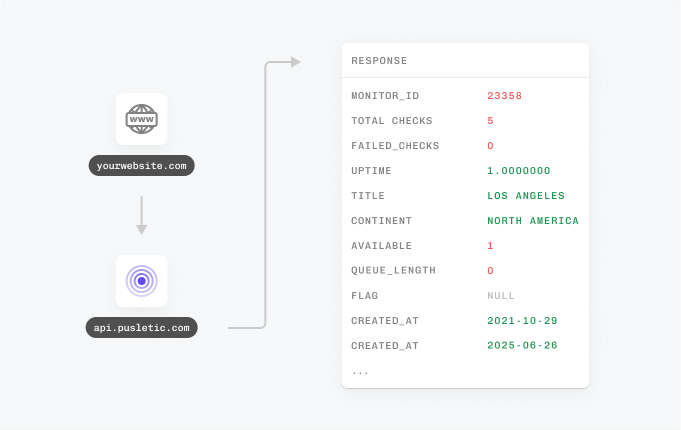
    The REST API covers monitors, heartbeats, status pages and alert channels, ships an OpenAPI spec and authenticates with a plain token. The MCP server and n8n integration are built on the same calls.

  • Heartbeats for everything scheduled

    Cron jobs, queue workers, backups and CI tasks ping a unique URL when they finish. When the ping does not arrive on time, you find out from an alert, not from a user asking where their data went.

  • A free plan that ships to production

    10 monitors, 3 status pages and custom domains, with commercial use allowed. Side projects and client work get real monitoring before anyone pays a cent.

"Tens of thousands of business owners from around the world rely on our service, and Pulsetic is the best platform there is to ensure we communicate any downtimes clearly and swiftly to our customers to avoid panic and disappointment. Getting setup on Pulsetic not only been smooth and easy but super joyful too, the design is stunning and customisable unlike any other monitoring platform we’ve used."

Leo Bassam
Leo Bassam

Founder, CEO at Plutio

"There's an easy way for you to monitor your online project. After all the hard work you have put into going live, you want to make sure that things keep running smoothly while you focus on the next project."

Chris Kalmar
Chris Kalmar

Founder at nineLemon

"Pulsetic is super easy to use and fast. The UI is very simple and clean, and it offers all the right features. The status page design is also great, and we really liked the fact that we could set up alert notifications in multiple channels."

Akis Laopodis
Akis Laopodis

Founder of HelpfulDocs

"The monitoring tool we've been waiting for. Super easy to set up monitoring, customizable status page design, and access to notifications across Slack, email and SMS. Pulsetic is awesome."

Andrei Negrau
Andrei Negrau

CEO at Cartloop.io

"Pulsetic helps us monitor all of our websites and webapps over at Pairing.dev. Before we used it, we had no idea how often services (e.g. heroku) were offline. Now we have complete control over it."

Till Carlos
Till Carlos

Founder at Pairing.dev

"Using Pulsetic is a big win for us! Our dev team can now deliver faster, with zero time spent monitoring our website uptime. Plus the interface is great and analytics proper."

Razvan Popescu
Razvan Popescu

Head of Marketing at AbstractAPI

Watch What You Ship

  • Web apps and pages

    HTTP and HTTPS checks watch every page that matters, and keyword monitoring confirms the page really rendered, not just that the server returned a 200.

  • APIs and endpoints

    API monitoring calls your endpoints the way a client would and alerts on bad status codes and slow responses.

  • Cron jobs and workers

    Heartbeat monitoring expects a ping when each job finishes, so a queue worker that died on Friday does not wait until Monday.

  • TCP services and ports

    TCP and port checks confirm databases, brokers and custom daemons are accepting connections, whatever port they are bound to.

  • SSL certificates

    SSL monitoring reminds you 14, 7 and 1 days before a certificate expires, across every project domain you run.

  • Domains

    Domain monitoring watches expiration dates, so the side project domain you forgot about stays yours.

And show it off

Publish a status page on your own domain, three come with the free plan, and on paid plans embed a live status badge in your product pages or docs.

How Does It Work for a Developer?

Minutes in the dashboard, or one HTTP call from your deploy script.

  • Add your app, API endpoints and cron jobs in the dashboard, or provision them from code on Team plans.

  • Point alerts at Slack, Telegram, Discord or webhooks, with SMS and phone calls for the failures that cannot wait.

  • Get back to shipping. Checks run from up to 15 locations, and an incident is confirmed before you are pinged.

  • For Web Developers

    Monitor every site and app you build, with keyword checks that prove pages render and SSL expiry covered.

  • For IoT Developers

    Watch internet-facing devices and brokers with ping, port and TCP checks, whatever ports they use.

  • For DevOps Teams

    Get the external view of production and route alerts through webhooks into your on-call tooling.

  • For Startup Teams

    Cover the landing page, app, API and crons on the free plan, and upgrade when the product takes off.

  • Bring in your whole team.

    Need access for more than one person? Pulsetic is for you. Easily manage access controls with specific rights and permissions for individual users, so you can collaborate without compromising on security.

  • Team access
  • API
  • Connect your API for even more flexibility.

    With Pulsetic’s API, you’ve got complete control: you can add custom statistics, monitors & automations, create bespoke rules and maintain granular control over who can access or modify monitoring information. Best suited for developers in scale-up or large enterprises.

FAQ: Monitoring for Developers

  • Can I manage monitors from code?

    Yes. One HTTP call with your API token creates a monitor, so a deploy script can register each new service as it ships. The same API manages heartbeats, domains, status pages and alert channels, and publishes an OpenAPI spec you can feed straight into a code generator. Access comes with the Team and Organization plans.

  • Does Pulsetic work with AI coding assistants?

    Yes. The official MCP server is built on the same REST API and exposes its capabilities as tools, so Claude, ChatGPT, Cursor and Windsurf can read your uptime data and create or manage monitors in plain English, authenticated with the same API keys.

  • How do I monitor cron jobs and background workers?

    With heartbeat monitoring. Give every scheduled task a unique URL to call when it finishes: a curl line at the end of a crontab entry, or one request from a worker or CI step. If the call does not come in on schedule, Pulsetic alerts you, so a backup that quietly exits 1 gets noticed the same night.

  • Is the free plan enough for a side project?

    Usually, yes. The free plan includes 10 monitors and 3 status pages with custom domains, and commercial use is allowed, so client work qualifies too. When you need faster checks, more monitors or API access, paid plans start at $9 per month.

  • How do alerts reach me?

    In the channels you already watch: Slack, Microsoft Teams, Telegram, Discord and email. Paid plans add SMS and phone calls for the alerts that should wake you, and webhooks carry the payload into anything you can code against.

  • How does Pulsetic avoid false alarms?

    Pulsetic checks from up to 15 locations worldwide and waits for several regions to agree before calling an incident. A flaky probe or a routing hiccup near a single data center never fires the alert, so when your phone buzzes, it is worth picking up.

  • Can I show uptime on my site or in my docs?

    Yes. A status badge is a copy-paste embed, available on the paid plans, that shows live uptime on any page you control, from product docs to a client dashboard. For the full picture, publish a status page on your own domain; the free plan includes three.

  • What does Pulsetic cost when I outgrow the free plan?

    Solo is $9 per month with 60-second checks. Team is $19 with 30-second checks from 15 regions, API, MCP and n8n access, 100 SMS and voice-call credits and white-label status pages. Two teammates are included, and extra seats are a flat $8 each.

Hey there 👋  Friends from designmodo are here to help!