-
Need a Better Stack

alternative?Try Pulsetic. Get website monitoring & beautiful status pages - for half the price.
No credit
card required.
$HTTP_PROTOCOL = (isset($_SERVER['HTTPS']) && ($_SERVER['HTTPS'] == 'on' || $_SERVER['HTTPS'] == 1)) || (isset($_SERVER['HTTP_X_FORWARDED_PROTO']) && $_SERVER['HTTP_X_FORWARDED_PROTO'] == 'https') ? 'https://' : 'http://'; $SITE_URL = $HTTP_PROTOCOL . $_SERVER['SERVER_NAME'] . '/'; ?>
Try Pulsetic. Get website monitoring & beautiful status pages - for half the price.
Imagine if your services went offline overnight - and you didn’t know about it. While you were asleep, a day went by for your customers on the other side of the world. They couldn’t access your website. They didn’t know why.
Pulsetic solves that problem for you. It monitors your uptime from 15 locations around the world, giving you and your customers beautiful, real-time updates in every language.
But there’s another reason people looking for a Better Stack alternative come to Pulsetic: the functionality you get for your money.
Let’s compare the two.
Beautiful status badges
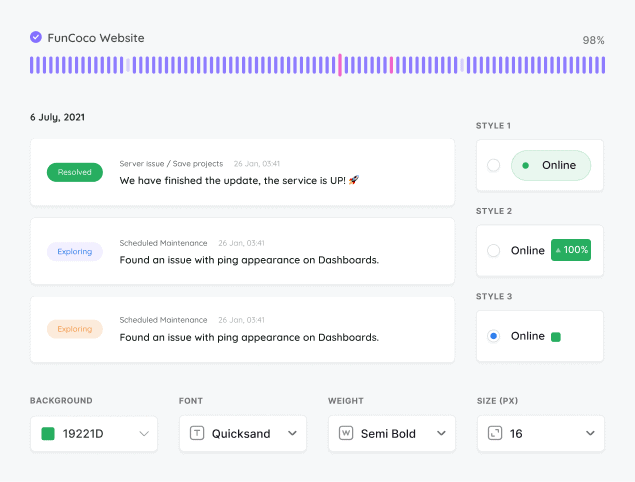
Unlike Better Stack, Pulsetic gives you a white labeled badge showing your service availability in real time - on any page you like. You can customize it to your brand in minutes: colors, fonts, symbols, text, and backgrounds. And if you need more freedom to make it yours, you can use Custom CSS instead.
30 second uptime checks
On their higher plans, Better Stack and Pulsetic both check things are OK every 30 seconds. If you want to, though, you can also space out the intervals between checks with Pulsetic. And if you’re constrained by budgets, Pulsetic will run checks every five minutes - completely free.
Support for every language
Better Stack works in English - and only English. The world’s 6 billion people who don’t speak English need a Better Stack alternative. Pulsetic, on the other hand, supports every language on earth: from Spanish to Swahili. So wherever your customers are, you can let them know what’s happening.
"Using Pulsetic is a big win for us! Our dev team can now deliver faster, with zero time spent monitoring our website uptime. Plus the interface and analytics are great."
Razvan Popescu
Head of Marketing at AbstractAPI
Free plans
Better Stack’s free plan matches Pulsetic’s for check times, and both give you up to 10 monitors for free. But while Better Stack’s free plan lets you create just 5 unique status pages, with Pulsetic, you can create as many as you need.
And unlike Better Stack, Pulsetic also gives you integrations and SSL monitoring - completely for free.
Team plans
Pulsetic’s Team plan monitors 50 services for $19/month. Better Stack includes only 10 monitors on its base plan, so reaching 50 means adding a $25/month monitor pack on top, which pushes it past $50/month. Pulsetic’s alternative to Better Stack also gives you complete status page and badge customization on the starter plan, plus notifications for up to 5,000 subscribers.
Organization plans
If you need to look after lots of websites or services, Pulsetic’s Organization plan ($49/month) gives you 300 monitors. On Better Stack, monitors come in $25/month packs of 50 on top of the base plan, so even 100 monitors runs to around $80/month. With Pulsetic you get roughly three times the monitors for less.
Better Stack
Free plan / trial
Free Plan
Free Plan
Price (USD/mo)
$9
$30
Monitoring
Check time
30 sec
30 sec
Choice of regional data centers
SSL monitoring
Keyword monitoring
Ping / ICMP monitoring
Port monitoring
TCP monitoring
Domain monitoring
Cron / heartbeat monitoring
Custom HTTP requests
Customized responses
API
MCP server
n8n integration
✕
Monitoring data retention
Up to 5 yr
13 mo
Status Pages
Incident updates
Status updates for subscribers via email
Maintenance windows
Status badges
Customized domain
Customized colors
Customized logo
Remove branding
Customized status page layout
✕
CSS customization
Custom email sender & templates
AI writing assistant
✕
Page translations
Password-protected status page
Notifications
Email alerts
SMS alerts
Phone call alerts
Slack alerts
MS teams alerts
Discord alerts
✕
Telegram alerts
✕
Mattermost alerts
✕
Webhooks alerts
Zapier alerts
Twilio alerts
✕
Datadog integration
Integration with SIGNL4
Analytics
See response times
Response time by location
✕
Custom date range reports
Scheduled email reports
✕
Security
Two-factor authentication
Single Sign-On (SAML)
Role-based access
Support
Chat
✕
Human Support
AI Support
✕
Helpdesk Articles
Email Support
Comparison based on publicly available information as of June 2026. Features and pricing change frequently, so please verify current details on each provider’s website.
See where your website is loading slowly
We’ll check your website response times from different locations around the world, so you know if there’s an issue in a particular region.
Alerts wherever you want them
Pulsetic lets you know the moment your website is down, through Slack, Telegram groups, Webhooks, email, SMS or voice call.
Never let your SSL expire again
We’ll let you know when it’s time to update your SSL certificate - so you can renew it before customers are seeing error messages.
2-minute setup · Cancel any time
No credit card needed
Better Stack has a free plan that includes around 10 monitors, one status page, and email and Slack alerts, with checks running every 3 minutes. Pulsetic also offers a free plan, and it adds things like SSL monitoring and alert integrations at no cost, plus you can create as many status pages as you need rather than being capped. If you mainly want uptime monitoring and clean status pages, Pulsetic's free tier goes further for that use case.
Better Stack's paid plans start at roughly $30 per month, and costs can climb quickly because monitoring, heartbeats, extra status pages, logs, and incident management are billed as separate modules and add-ons. Pulsetic starts at $9 per month and keeps uptime monitoring and status pages together in one simple plan. For teams that just need reliable monitoring and a status page, Pulsetic is usually the cheaper and more predictable choice.
Better Stack is built as a broad observability suite covering incident management, on-call scheduling, and log management, which is powerful but can be more complex and expensive than many teams need. Pulsetic stays focused on the two things most people actually want: uptime monitoring and status pages. You get HTTP(S), SSL, keyword, ping, port, TCP, domain, and cron or heartbeat checks plus status pages and badges, without paying for observability features you will never use.
Better Stack runs checks every 3 minutes on its free plan and unlocks 30-second checks on paid plans. Pulsetic also offers 30-second checks, so you get the same fast monitoring frequency. The difference is mostly in price and scope, since Pulsetic delivers those checks on the $19 Team plan.
Better Stack is an all-in-one observability platform best known for incident management, on-call and escalation scheduling, and log management, alongside uptime monitoring and status pages. That breadth suits engineering teams that want logs, metrics, and on-call workflows in one place. If you do not need full observability and just want to know your websites are up and keep customers informed, a focused tool like Pulsetic covers that more simply and affordably.
Yes. Moving to Pulsetic mainly means recreating your monitors and status page, which is quick since you only need your endpoint URLs and preferred check settings. Pulsetic supports HTTP(S), SSL, keyword, ping, port, TCP, domain, and cron or heartbeat monitoring, so the checks you ran on Better Stack have an equivalent. You can also rebuild your status page with subscriber notifications and add status badges to your own pages.
Both tools offer hosted status pages, but Better Stack limits the number of status pages on lower tiers and charges for additional public pages as add-ons. Pulsetic lets you create as many status pages as you need, including on the free plan, with subscriber notifications and embeddable status badges for any page. For teams whose main goal is transparent uptime communication, Pulsetic gives you more status page flexibility for less.
Setting up Pulsetic is fast: you add a URL, pick a check interval, choose your alert channels, and publish a status page, often within a few minutes. Because it focuses on uptime monitoring and status pages rather than a full observability stack, there is much less to configure than with Better Stack. That keeps it easy for non-engineers to manage and light to maintain day to day.
Stay online, all the time, with Pulsetic's uptime prime.
By Designmodo
Designmodo Inc. 169 Madison Ave, #79627, New York, NY 10016, United States
Copyright © 2010-2026