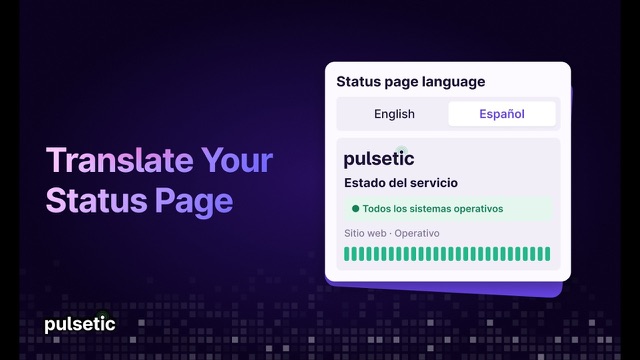
Your status page, in your customers’ language

Pick one of 50 languages, and the status messages, labels and section text on your status page fill in with ready-made wording, dates and times included. Adjust anything you like, then save. It comes with every Pulsetic plan, the free one included.

Free plan: 10 monitors and 3 status pages, no credit card.

Pick a language. Make the words yours.

Every status page has its own Translate screen. Choose a language from the Translate all fields to list, and every field fills in with a ready-made translation while the date language switches to match. Then change any wording, so the page says exactly what your team would say. Nothing is saved until you click Update.

On the Translate screen

Language

Translate all fields to

German (Deutsch)

Reset to defaults

Button Get Updates

System Status

All Systems Operational

Alle Systeme betriebsbereit

Major Systems Outage

Schwerwiegender Systemausfall

Partial Systems Outage

Teilweiser Systemausfall

Uptime

Incidents

Maintenances

Date and Time Language

German

On your status page

Updates erhalten

Alle Systeme betriebsbereit

Verfügbarkeit

startup.com

api.startup.com

app.startup.com

Picking German fills in every field with the wording shown and sets the date language to German. You can change any field before you click Update. The Get Updates button belongs to subscriber notifications, which only some plans include.
  • One language per page

    Each page carries one set of wording and one date language, with no switcher for visitors. For a second language, publish a second page: the free plan includes three.

  • Dates in the same language

    Picking a language sets the Date and Time Language to match, so the dates and times on the page read like the words around them. You can also change it on its own.

  • The rest is already yours

    Monitor names are whatever you call them. So are incident updates and maintenance notices, and subscriber emails follow the page’s language settings.

What the Translate screen covers

The Language list at the top fills in every field at once. Each field below it replaces one piece of the page’s built-in text, and you can change any of them. It is one of the settings every Pulsetic status page has, on every plan.

FieldWhat it changes on the page
LanguageThe Translate all fields to list. Pick one of 50 languages and every field below fills in with ready-made wording, with Date and Time Language set to match. Reset to defaults, next to it, puts back the standard English text and English dates.
Get Updates buttonThe Get Updates button, and its text in the subscription section.
Manage Subscription buttonThe Manage Subscription button, and its text in the subscription section.
System StatusThe overall status line: All Systems Operational, Partial Systems Outage and Major Systems Outage.
UptimeThe label for the uptime percentage.
IncidentsThe text in the incidents section.
MaintenancesThe text in the maintenances section.
PasswordThe label on the password field of a password-protected page.
Date and Time LanguageThe language of dates and times on the page, picked from a list.

Four of these belong to features that only some plans include: the two subscription buttons go with subscriber notifications, the maintenances text with scheduled maintenance and the password label with password protection.

Ready-made wording in 50 languages

Any of these fills in the whole Translate screen, ready for you to adjust. Arabic, Hebrew and Persian text shows on the page, but the layout stays left to right.

  • Albanian
  • Arabic
  • Azerbaijani
  • Bengali
  • Bulgarian
  • Catalan
  • Chinese (Simplified)
  • Chinese (Traditional)
  • Croatian
  • Czech
  • Danish
  • Dutch
  • English
  • Estonian
  • Filipino
  • Finnish
  • French
  • Georgian
  • German
  • Greek
  • Hebrew
  • Hindi
  • Hungarian
  • Icelandic
  • Indonesian
  • Italian
  • Japanese
  • Kazakh
  • Korean
  • Latvian
  • Lithuanian
  • Macedonian
  • Malay
  • Norwegian
  • Persian
  • Polish
  • Portuguese (Brazil)
  • Portuguese (Portugal)
  • Romanian
  • Russian
  • Serbian
  • Slovak
  • Slovenian
  • Spanish
  • Swahili
  • Swedish
  • Thai
  • Turkish
  • Ukrainian
  • Vietnamese

Set it up in four steps

  • 1Open Translate

    In Status Pages, click the three dots next to the page you want to translate, then choose Translate.

  • 2Pick a language

    Choose one of 50 languages from the Translate all fields to list. Every field fills in, and the date language changes to match.

  • 3Adjust any text

    Change any wording you want said differently, or pick another date language. Reset to defaults puts back the standard English.

  • 4Click Update

    Nothing is saved until you do, so you can try a language and read through the wording first.

The help center guide has screenshots of the Translate screen.

  • Translate a status page in a few clicks

    Pick a language, adjust any wording, and set the date language so dates match the rest of the page.

    How to Translate a Status Page into Another Language · 1:22

  • How to Translate a Status Page into Another Language

FAQ: Status Page Translation

  • Is status page translation on the free plan?

    Yes. It comes with every Pulsetic plan, the free one included. The free plan covers 10 monitors and 3 status pages, each on a domain you own, with no credit card.

  • Do I have to write the translations myself?

    No. Pick one of 50 languages from the Translate all fields to list and every field fills in with a ready-made translation, with the date language set to match. Then adjust any wording you want said differently. Nothing changes on the page until you click Update, and if you have already edited fields, Pulsetic asks before a new pick replaces them.

  • Can one status page show more than one language?

    No. Each page has one set of wording and one date language, and visitors get no language switcher. To reach customers in two languages, publish a page for each, at its own address. The free plan includes three status pages.

  • Are incident updates and monitor names translated?

    No. Picking a language leaves them alone, because you write them yourself. Monitor names, incident updates and maintenance notices appear exactly as you wrote them.

  • Do subscriber emails use the page's language?

    Yes. Emails to subscribers follow the page's language settings. The pricing page lists which plans include subscriber notifications.

  • Can I use it to change the English wording?

    Yes. Whatever you put in a field replaces the page's default text, so the same screen works for rewording the English, for example “Everything is running” in place of “All Systems Operational”. Reset to defaults puts back the standard English text and English dates.

  • Which languages can I pick?

    Any of the 50 on the list, from Albanian to Vietnamese, including Chinese (Simplified and Traditional) and Portuguese for Brazil and for Portugal. For a language that is not on it, start from English or the closest language and rewrite each field in your own words.

  • Do right-to-left languages work?

    Arabic, Hebrew and Persian are on the list, and their text shows on the page, but the page layout stays left to right.