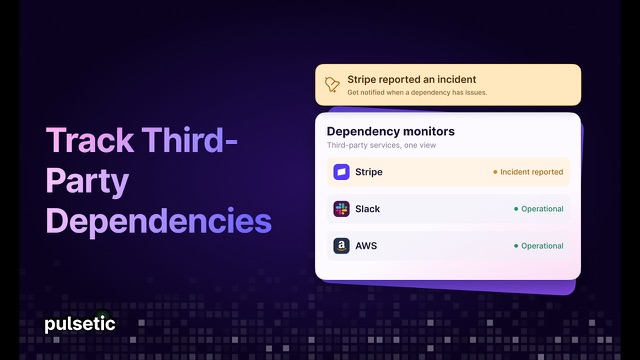
Get an email when a service you depend on has an incident

Your product runs on other people's services: payments, email delivery, hosting, AI models. Pick them from a catalogue of 4,400+ services, and Pulsetic emails you when a provider opens an incident, posts an update and resolves it. You know it is them, not you, before anyone opens the logs.

When something breaks, the first question is whether it is you or them

  • Rule out someone else's outage first

    Checkout errors, emails that never arrive, a deploy that hangs. Before your team digs through its own code, the alert says whether Stripe, SendGrid or GitHub has already declared an incident.

  • Follow the incident to the end

    You get an email when the provider opens the incident, each time it posts an update, and when it marks the incident resolved. Nobody has to keep refreshing a status page to see whether anything changed.

  • Tell your customers what is behind it

    Add a dependency to your status page and visitors see its incident timeline next to your own monitors, so a provider's outage is not mistaken for yours.

  • One inbox instead of a dozen status pages

    Every provider publishes its status differently and emails in its own format, if it emails at all. Dependency monitors bring them into the same Pulsetic dashboard and the same alert format.

  • 90 days of incident history

    See how often a provider has incidents, how many were major, and how long it usually takes to resolve one. It is as useful when choosing a vendor as it is during an outage.

Trusted by teams at companies around the world

  • One page for every provider

    Each dependency monitor gets its own page in your dashboard, built from the incidents the provider reports and from Pulsetic's own response time checks.

    Status right now

    Whether the service is operational, and how long ago its last incident was resolved.

    A 90-day record

    Every incident, split into major and minor, with the median time to resolve.

    Response time

    Checked from New York, Singapore, Bangalore and Toronto.

    Recent incidents

    Impact, status, start time and duration for each one.

  • Claude

    Operational

    All systems operational. Last incident resolved 2 hours ago.

    105

    Incidents, 90 days

    33

    Major or critical

    72

    Minor

    1h 1m

    Median resolution

    Response time by location, ms

    New YorkSingaporeBangaloreToronto

    Intermittent error spikes for Claude Mythos 5.1 and Claude Fable 5.1Resolved · started 15 Sep, 12:48

    Major

    1h 26m

    Elevated latency on the Claude API for some usersResolved · started 11 Sep, 00:43

    Minor

    1h 40m

    Degraded functionality for Claude Cowork on WindowsResolved · started 10 Sep, 18:54

    Major

    4d 3h 20m

    Delays in credit purchasesResolved · started 2 Sep, 02:26

    Minor

    1h 57m

    A Claude dependency monitor on 15 September 2026, simplified.

"Pulsetic made monitoring something I barely think about anymore. The interface is clean and the tracking is real-time, so I can glance at my site’s performance and get back to work."

Koen Kanters
Koen Kanters

Senior Software Engineer at ASML

"Pulsetic is easy-to-use and simple to get started. As an agency, I like that it includes unlimited status pages, because I can create one for each of my clients. Pulsetic includes every alert channel that I want, and advanced settings that give me greater confidence in the uptime. I can require that a response include certain text and respond within a certain timeframe in order for a site to be considered online. This gives me assurance that we would be notified if there were major performance issues or a bad deployment that made the site unusable. These features come with every paid plan, so our monthly bill is predictable. The API is a huge bonus on the teams plan. We have used it to add maintenance windows for certain monitors automatically based on events that happen in other software we use."

Christopher Morbitzer

CEO at NorthBuilt

"Pulsetic’s monitoring is easy to set up via their super clean, user-friendly UI. I was up and running within only a few minutes. A helpful knowledge base is available for webmasters to refer to if needed. Pulsetic’s pricing is also some of the most competitive in the industry. I highly recommend them for emerging and established agencies alike."

Scott Werley
Scott Werley

Owner at Sporulate Design

"Pulsetic is easy to set up and integrate. You don’t need much time to get it running. The interface is clear and simple. It’s easy to see what’s going on at a glance. The design looks great, too. I had no trouble finding what I needed and monitoring my sites is straightforward. If you want a simple tool that works well, Pulsetic is a good choice."

Aryo Sayogha
Aryo Sayogha

CEO at MBDC Media

"The monitoring tool we’ve been waiting for. Super easy to set up monitoring, customizable status page design, and access to notifications across Slack, email and SMS. Pulsetic is awesome."

Andrei Negrau
Andrei Negrau

CEO at Siena AI

"Tens of thousands of business owners from around the world rely on our service, and Pulsetic is the best platform there is to ensure we communicate any downtimes clearly and swiftly to our customers to avoid panic and disappointment. Getting setup on Pulsetic not only been smooth and easy but super joyful too, the design is stunning and customisable unlike any other monitoring platform we’ve used."

Leo Bassam
Leo Bassam

Founder, CEO at Plutio

"Pulsetic cut down our uptime monitoring work a lot. We automated uptime tracking and SLA reporting, which took a chunk of manual effort out of our monthly and annual reports. The Slack and email alerts let the team jump on problems quickly, and the API is what really sold us, since we point a dedicated health-check endpoint at it and pull uptime data straight into our internal workflows."

Mariana Kodama
Mariana Kodama

Treasurer, Fundacion Jorge Luis Borges

"There’s an easy way for you to monitor your online project. After all the hard work you have put into going live, you want to make sure that things keep running smoothly while you focus on the next project."

Chris Kalmar
Chris Kalmar

Founder at nineLemon

"Pulsetic is fast and genuinely easy to use. The UI is clean and has the features we actually needed, the status pages look good, and being able to route alerts to several channels was a real plus for us."

Akis Laopodis
Akis Laopodis

Founder at Qurioos

"Pulsetic helps us monitor all of our websites and webapps over at Pairing.dev. Before we used it, we had no idea how often services (e.g. heroku) were offline. Now we have complete control over it."

Till Carlos
Till Carlos

Founder at Pairing.dev

"Using Pulsetic is a big win for us! Our dev team can now deliver faster, with zero time spent monitoring our website uptime. Plus the interface is great and analytics proper."

Razvan Popescu
Razvan Popescu

Head of Marketing at AbstractAPI

How it works

  • 1. Find the service

    Search the catalogue of 4,400+ services by name or category, from payment processors to AI platforms.

  • 2. Add it as a dependency monitor

    It takes one click. The Free plan includes one dependency monitor, and paid plans include up to 30.

  • 3. Get the emails

    Pulsetic emails you when the provider opens, updates or resolves an incident. Add the dependency to your status page too, if your customers should see it.

4,400+ services you can monitor

Every service in the Pulsetic status directory can become a dependency monitor. Here are some of the ones teams rely on most.

Browse all services

FAQ: Dependency Monitoring

  • What is dependency monitoring?

    Dependency monitoring tracks the third-party services your product relies on, such as payment processors, hosting providers, email delivery and AI platforms. Pulsetic follows the incidents each provider reports and emails you when one is opened, updated or resolved.

  • Which services can I monitor?

    Any of the 4,400+ services in the Pulsetic status directory, across payments, cloud hosting, developer tools, communication, AI platforms and more than 150 other categories.

  • How will I be alerted?

    By email. Pulsetic sends one when the provider opens an incident, another each time it posts an update, and a final one when the incident is resolved.

  • How many dependency monitors can I add?

    The Free plan includes 1 dependency monitor, Solo includes 3, Team 10 and Organization 30. On a paid plan you can add more for $0.20 each per month.

  • Can I show a dependency on my status page?

    Yes. Add it to your Pulsetic status page and it appears next to your own monitors with a 90-day incident timeline, so visitors can see when a problem comes from a provider rather than from you.

  • How is dependency monitoring different from uptime monitoring?

    Uptime monitoring checks a website or endpoint you run. Dependency monitoring watches services you rely on but do not run, and tells you about the incidents their providers declare, including problems a check of their homepage would never show, like elevated API errors for a single product. Most teams use both.

  • Do I need to install anything?

    No. Pick a service in your Pulsetic account and it becomes a dependency monitor. There is nothing to install and no API key to share.