-
Need an Umami
alternative?Try Pulsetic. Real User Monitoring with Core Web Vitals on by default, uptime checks and status pages from $9 - plus a free plan to start.
No credit
card required.
$HTTP_PROTOCOL = (isset($_SERVER['HTTPS']) && ($_SERVER['HTTPS'] == 'on' || $_SERVER['HTTPS'] == 1)) || (isset($_SERVER['HTTP_X_FORWARDED_PROTO']) && $_SERVER['HTTP_X_FORWARDED_PROTO'] == 'https') ? 'https://' : 'http://'; $SITE_URL = $HTTP_PROTOCOL . $_SERVER['SERVER_NAME'] . '/'; ?>
Try Pulsetic. Real User Monitoring with Core Web Vitals on by default, uptime checks and status pages from $9 - plus a free plan to start.
Credit where due: Umami is excellent and generous. It is open source under the MIT license, free and unlimited when you self-host, cookieless by design, and every tier includes goals, custom events, funnels, retention reports, UTM and revenue tracking. Since v3.1 it even offers an opt-in Core Web Vitals report.
The honest gaps are narrower but real. Vitals are an opt-in extra, and a Web Vitals report only: no per-resource timing, no error tracking. And nothing in Umami watches your site from outside: no uptime checks, no alerting, no status pages. An analytics dashboard cannot page you at 3am.
That’s why people searching for an Umami alternative land on Pulsetic: performance on by default with error context on every pageview, plus the outside view of 30-second uptime checks, alerts and status pages, hosted with no server to maintain.
Let’s compare the two.
Vitals on every pageview, not opt-in
Umami added a Core Web Vitals report in v3.1, but it is opt-in and vitals-only. Pulsetic collects LCP, CLS, INP and FCP by default, with load time percentiles (p50, p75, p95) and JS error context on every pageview.
The outside view
Nothing in Umami checks your site from outside. Pulsetic pings it every 30 seconds from up to 15 regions and alerts you by Slack, Teams, Discord, Telegram, email, SMS or phone call before customers start asking.
Status pages, even on the free plan
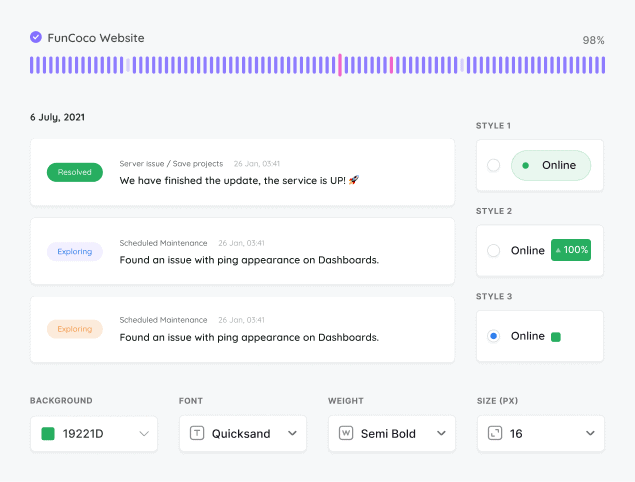
Pulsetic includes customizable status pages with subscriber emails, incident updates and maintenance windows, starting on the free plan. With Umami you would still need a second tool for the whole uptime side of the job.
“Pulsetic has transformed my website monitoring experience with its intuitive interface and real-time tracking capabilities. I love how effortlessly I can keep tabs on my site’s performance, ensuring everything runs smoothly!”
Koen Kanters
Senior Software Engineer at ASML
Free plans
Umami’s free Hobby plan covers 100,000 events a month on 1 website, with 6-month retention, no API access and community support. Pulsetic’s free plan includes 10 monitors, status pages and 1,000 RUM pageviews a month, commercial use allowed.
Paid plans
Umami Cloud is $20 a month for 1 million events and 20 sites, $200 for Business with session replays. Pulsetic’s alternative to Umami starts at $9 for 10,000 RUM pageviews plus uptime monitors and status pages, with whitelabel and 30-second checks from $19.
Self-hosting trade-off
Self-hosted Umami is free and unlimited, but it is your Node.js and PostgreSQL server to run, patch and back up. Pulsetic is hosted only: nothing to maintain, and uptime checks from up to 15 external regions are not something your own box can do.
Umami
Free plan / trial
Free Plan
Free Plan (100k events)
Price (USD/mo)
$9
$20 Cloud; $0 + your server
Monitoring
Check time
30 sec
n/a
Real User Monitoring (RUM)
Web Vitals opt-in
Choice of regional data centers
n/a
SSL monitoring
✕
Keyword monitoring
✕
Ping / ICMP monitoring
✕
Port monitoring
✕
TCP monitoring
✕
Domain monitoring
✕
Cron / heartbeat monitoring
✕
Custom HTTP requests
✕
Customized responses
✕
API
Pro plan and up
MCP server
✕
n8n integration
✕
Cloudflare IP allowlisting
n/a
Monitoring data retention
Up to 5 yr
n/a
Status Pages
Incident updates
✕
Status updates for subscribers via email
✕
Maintenance windows
✕
Status badges
✕
Customized domain
✕
Customized colors
✕
Customized logo
✕
Remove branding
✕
Customized status page layout
✕
CSS customization
✕
Custom email sender & templates
✕
AI writing assistant
✕
Page translations
✕
Password-protected status page
✕
Notifications
Email alerts
✕
SMS alerts
✕
Phone call alerts
✕
Slack alerts
✕
MS teams alerts
✕
Discord alerts
✕
Telegram alerts
✕
Mattermost alerts
✕
Webhooks alerts
✕
Zapier alerts
✕
Twilio alerts
✕
Datadog integration
✕
Integration with SIGNL4
✕
Analytics
See response times
n/a
Response time by location
n/a
Custom date range reports
Scheduled email reports
Cloud plans only
Web Analytics & RUM
Cookieless tracking
Tracking script size
Under 4 KB
2 KB
Core Web Vitals (field data)
Opt-in
Load time percentiles (p50/p75/p95)
Web Vitals only
JS error tracking
✕
Realtime visitors
Traffic breakdowns (pages, geo, devices)
Goals / custom events
✕
Analytics data retention
3 mo - 5 yr by plan
6 mo - 5 yr by plan
Self-hostable
✕
Security
Two-factor authentication
✕
Single Sign-On (SAML)
Enterprise only
Role-based access
Support
Chat
✕
Human Support
Paid plans
AI Support
✕
Helpdesk Articles
Email Support
Paid plans
Comparison based on publicly available information as of July 2026. Features and pricing change frequently, so please verify current details on each provider’s website.
Trusted by teams at companies around the world
See where your website is loading slowly
We’ll check your website response times from different locations around the world, so you know if there’s an issue in a particular region.
Alerts wherever you want them
Pulsetic lets you know the moment your website is down, through Slack, Telegram groups, Webhooks, email, SMS or voice call.
Never let your SSL expire again
We’ll let you know when it’s time to update your SSL certificate - so you can renew it before customers are seeing error messages.
2-minute setup · Cancel any time
No credit card needed
Generous, open-source web analytics. Self-hosting is free and unlimited under the MIT license, the script is under 2 KB and cookieless, and every tier includes goals, custom events, funnels, retention reports, UTM and revenue tracking. Since v3.1 it even offers an opt-in Core Web Vitals report. Pulsetic focuses on a different question: not what happened on your site, but how fast it was and whether it was up at all.
Self-hosting is free and unlimited; you provide the Node.js and PostgreSQL server and keep it running. Umami Cloud has a free Hobby plan (100,000 events a month, 1 website, 6-month retention, no API access), Pro at $20 a month for 1 million events and 20 sites, and Business at $200 with 5-year retention and session replays. Pulsetic starts free, and its $9 Solo plan includes 10,000 RUM pageviews plus 10 uptime monitors and status pages.
Yes, since v3.1 (April 2026): an opt-in report you enable with a data-performance attribute on the script tag, covering LCP, INP, CLS, FCP and TTFB at p50, p75 and p95, per page, device and browser. It is a Web Vitals report only, with no per-resource timing and no error tracking. Pulsetic collects vitals by default on every pageview and adds load time percentiles and JS error context.
No. Umami has no uptime monitoring, no alerting of any kind and no status pages. During an outage the dashboard just shows traffic dropping. Pulsetic checks your site every 30 seconds from up to 15 regions and alerts you via Slack, Microsoft Teams, Discord, Telegram, email, SMS or phone call.
No. Pulsetic does not track goals, custom events, funnels or UTM campaigns, so if your work depends on conversion reporting, keep Umami for it. Both scripts are small and cookieless, so the two run side by side well: Umami for product and marketing questions, Pulsetic for performance and uptime.
No. Like Umami, Pulsetic sets no cookies and writes nothing to localStorage. Umami counts visitors with a server-side hash that rotates monthly; Pulsetic does not need to count unique visitors at all, so there is no client-side visitor identifier of any kind. The script is under 4 KB and sends a single beacon per pageview, with no sampling.
No, Pulsetic is a hosted service only. If self-hosting is a hard requirement, Umami is the right direction. The trade-off runs the other way too: with Pulsetic there is no server to run, patch or back up, and external uptime monitoring from up to 15 regions cannot come from your own box anyway.
When the questions you are asking change: you care less about events and campaigns and more about why the site felt slow, whether Core Web Vitals pass, and who tells you when the site goes down. Pulsetic answers those from $9, includes status pages, and has a free plan to start. If you need both sets of answers, the two scripts coexist happily.
Stay online, all the time, with Pulsetic's uptime prime.
By Designmodo
Designmodo Inc. 169 Madison Ave, #79627, New York, NY 10016, United States
Copyright © 2010-2026